

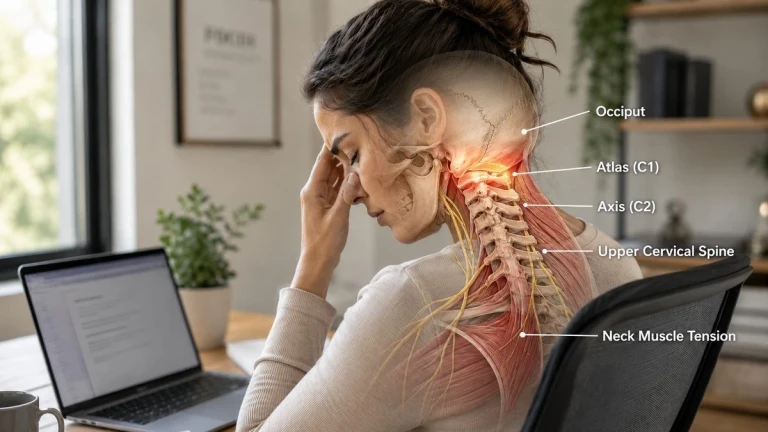
Head tension is one of the most common complaints patients describe, but it is often misunderstood.
Many people feel pressure across the forehead, tightness around the temples, heaviness at the base of the skull, or soreness that seems to wrap around the head like a band.
Because the discomfort is felt in the head, it is easy to assume the problem starts there.
But head tension is rarely just about the head.
The muscles, joints, nerves, posture, and movement patterns of the neck can all influence how tension is felt. The upper cervical spine, which includes the atlas and axis at the top of the neck, plays an especially important role because of its close relationship with head position, nerve communication, balance, muscle tone, and the way the body manages stress.
This does not mean every headache or head tension pattern comes from the spine. Head pain can have many causes, and some require medical attention.
But for many patients, recurring head tension may be connected to the way the neck is functioning, especially when symptoms are paired with neck stiffness, shoulder tightness, poor posture, jaw tension, or discomfort at the base of the skull.
What Does Head Tension Feel Like?
Tension-type headaches are commonly described as dull, aching head pain with pressure or tightness across the forehead, sides of the head, or back of the head. Tenderness in the scalp, neck, and shoulder muscles may also be present.
Patients may describe symptoms such as:
- Pressure around the forehead or temples
- Tightness at the base of the skull
- Neck stiffness with head discomfort
- Shoulder tension that travels upward
- A heavy feeling in the head
- Discomfort after computer work or long sitting
- Morning head tension after sleep
- Sensitivity around the scalp or jaw
For some people, head tension appears during stressful workdays. For others, it starts after hours of screen use, poor sleep, prolonged driving, or repeated forward-head posture. The pattern may come and go at first, then become more frequent when the underlying stress on the body is not addressed.
The Neck and Head Work Together
The head does not sit independently from the rest of the body. It is supported by the cervical spine, controlled by layers of muscles, and coordinated by the nervous system.
When the neck becomes tight, restricted, or overloaded, the surrounding tissues may begin to compensate.

Poor posture, especially leaning forward over a computer or phone, can strain the neck muscles. Mayo Clinic notes that poor posture from computer work or hunching can contribute to neck muscle strain.
Over time, this strain can create a cycle of stiffness, muscle guarding, reduced mobility, and increased tension around the head and shoulders.
This is why many patients with head tension also notice neck symptoms. They may not always call it neck pain. They may say they feel “tight,” “compressed,” “stiff,” or “locked up.” But the pattern often points to a larger relationship between the upper spine and the head.
Cervicogenic Headache: When the Neck Refers Pain to the Head
One important condition to understand is cervicogenic headache. A cervicogenic headache is head pain that originates from the neck. Cleveland Clinic describes it as pain that can radiate from an injury or condition affecting the cervical spine.
Cervicogenic headaches are different from classic tension headaches, but the symptoms can overlap. Patients may feel pain that begins in the neck or base of the skull and travels toward the head. The discomfort may be one-sided, worsened by neck movement, or associated with reduced range of motion.
This matters because the location of pain does not always reveal the source of the problem. A person may feel the pain in the head, but the irritation may involve the upper cervical joints, muscles, or nerves.
Why the Upper Cervical Spine Matters
The upper cervical spine is the area at the very top of the neck, directly beneath the skull. It includes the atlas, also known as C1, and the axis, known as C2.
These vertebrae help support the head and allow important movements such as rotation, nodding, and subtle postural adjustments.
Because this region sits close to the base of the skull, it has a major influence on head posture and neck muscle tone. Small changes in alignment, motion, or joint function may affect how the body distributes stress through the neck, shoulders, and head.
Upper cervical chiropractic care focuses on evaluating this area with precision. The goal is not simply to “crack the neck” or chase symptoms. T
he goal is to understand whether the upper neck is contributing to abnormal stress patterns that may be influencing head tension, neck stiffness, posture, or nervous system irritation.
For patients with recurring head tension, an upper cervical evaluation may look at:

- Head and neck posture
- Upper neck mobility
- Muscle imbalance near the base of the skull
- Shoulder and jaw tension patterns
- History of trauma, falls, or car accidents
- Work posture and screen habits
- Sleep position and pillow support
- Balance or dizziness symptoms when present
This broader view helps determine whether the head tension is part of a larger mechanical or neurological pattern.
Stress, Posture, and Muscle Guarding
Head tension is often connected to more than one factor. Stress can increase muscle tone. Poor posture can overload the neck. Long hours at a desk can reduce movement.
Sleep position can strain the upper cervical area. Jaw clenching can add more tension around the temples and skull.
When the body senses stress or instability, muscles may tighten to protect the area. This guarding may be helpful in the short term, but over time it can become part of the problem.
Tight muscles restrict motion. Restricted motion creates more compensation. Compensation increases fatigue. Eventually, the patient feels pressure, tightness, or discomfort.
This is why head tension can return even after rest, stretching, or pain medication. Temporary relief may help, but the deeper question is: why is the body creating that tension in the first place?
How Upper Cervical Chiropractic May Help
Upper cervical chiropractic care may help by identifying and correcting dysfunction in the top of the neck that contributes to abnormal tension patterns.
When the upper cervical spine moves and functions better, the surrounding muscles may not need to guard as much. Improved alignment and motion may also help the body manage posture more efficiently.
For some patients, this may lead to less neck stiffness, improved comfort at the base of the skull, better head mobility, and fewer recurring tension patterns.
Each patient is different, and care should always be based on a proper examination rather than assumptions.
An upper cervical chiropractor may also provide guidance on posture, ergonomics, sleep position, gentle mobility, breathing mechanics, and daily habits that reduce repeated strain.
Simple Daily Habits That May Reduce Head Tension

Small changes can make a meaningful difference, especially when head tension is related to posture or neck strain.
- Keep screens at eye level instead of looking down for long periods.
- Take movement breaks during desk work.
- Avoid holding the phone between the shoulder and ear.
- Use a pillow that supports a neutral neck position.
- Relax the jaw and avoid prolonged clenching.
- Stay hydrated and maintain consistent sleep habits.
- Pay attention to early signs of neck stiffness before tension builds.
Final Thought
Head tension may be felt in the head, but the cause is often more complex. The neck, posture, muscles, stress response, sleep position, and nervous system can all play a role.
For patients who deal with recurring pressure, tightness, or discomfort, looking only at the head may miss part of the story.
Upper cervical chiropractic care offers a focused way to evaluate the top of the neck and its relationship to head tension. When the upper cervical spine is functioning better, the body may be able to move, adapt, and recover with less strain.
If head tension keeps returning, it may be time to look beyond temporary relief and ask a better question:
Is the head tension coming from the head alone, or is the neck part of the pattern?
FAQ
1. Can neck problems cause head tension?
Yes, neck stiffness, poor posture, muscle tension, and upper cervical dysfunction may contribute to head tension or headache-like pressure in some patients.
2. What is the difference between a tension headache and a cervicogenic headache?
A tension headache often feels like pressure or tightness around the head, while a cervicogenic headache starts from a neck-related problem and refers pain into the head.
3. Can upper cervical chiropractic help with head tension?
Upper cervical chiropractic may help when head tension is connected to neck alignment, restricted motion, muscle guarding, or stress in the upper cervical spine.
4. When should I worry about head tension?
Seek medical care immediately for sudden severe headache, neurological symptoms, vision changes, confusion, fever, weakness, or headache after injury.
Find Relief in Charleston
If you’re struggling with chronic neck pain, numbness, or balance issues, don’t wait for symptoms to worsen.
Dr. Will Youngblood’s practice at 1411 Ashley River Road, Charleston, SC 29407 specializes in gentle, precise upper cervical adjustments that restore alignment, reduce nerve pressure, and help your body heal naturally.
📞 Call (843) 225-5855 to schedule a consultation or learn whether upper cervical care may be right for you.
Your spine protects your life; take care of it today.


Leave a comment