

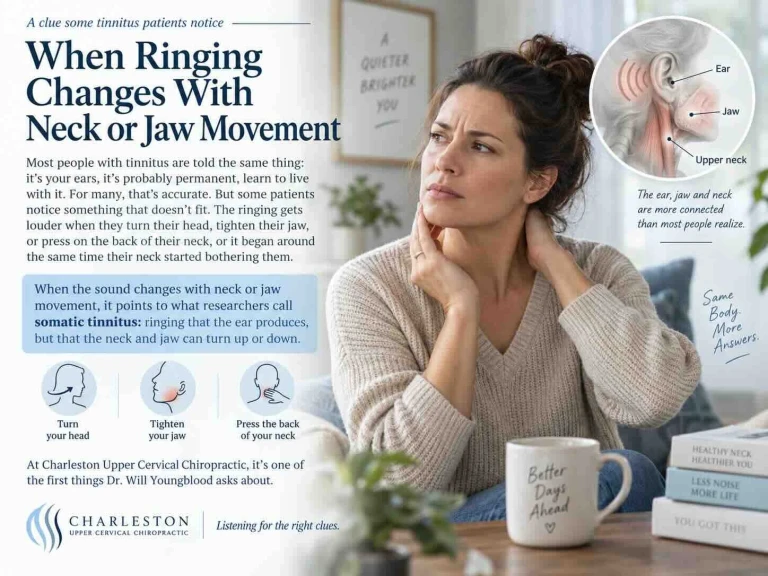
Most people with tinnitus are told the same thing: it's your ears, it's probably permanent, learn to live with it. For many, that's accurate. But some patients notice something that doesn't fit. The ringing gets louder when they turn their head, tighten their jaw, or press on the back of their neck, or it began around the same time their neck started bothering them.
That detail matters. When the sound changes with neck or jaw movement, it points to what researchers call somatic tinnitus: ringing that the ear produces, but that the neck and jaw can turn up or down. At Charleston Upper Cervical Chiropractic, it's one of the first things Dr. Will Youngblood asks about.
How Can the Neck Affect What You Hear?
In the brainstem, the first relay station for sound is called the cochlear nucleus. It doesn't only receive signals from the ear. It also receives input from the nerves of the upper neck and the jaw.
That wiring normally helps the brain keep track of head position relative to sound. But when the upper neck is irritated or misaligned, that steady stream of neck input can raise the "volume" in the auditory system. The result is a ringing, buzzing, or hissing that fluctuates with how the neck and jaw are loaded.
What Are the Signs That Tinnitus Involves the Neck?
The pattern tends to look like this:
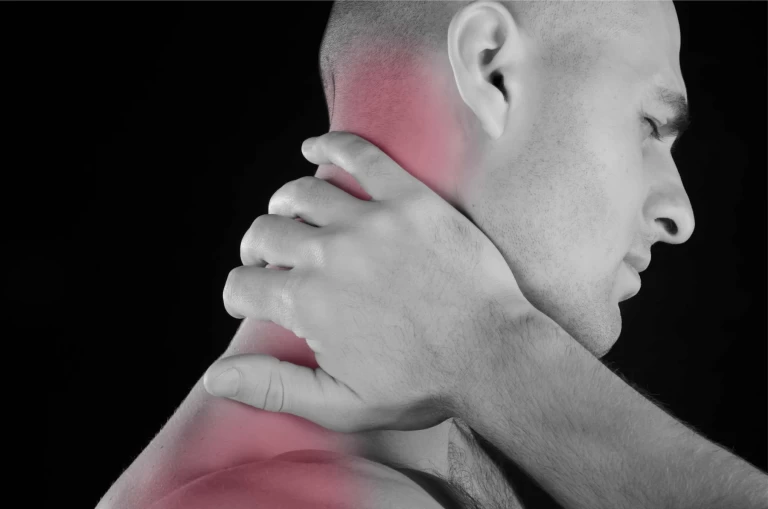
- The sound changes when you turn your head, clench your teeth, or push your jaw forward
- It's louder on one side, often the same side as neck tightness
- It started after a whiplash injury, a fall, or a period of neck pain
- It comes with neck stiffness, headaches at the base of the skull, or jaw tension
- It's worse after long hours at a desk or on the phone, and eases on days your neck feels better
Patients from James Island, Mount Pleasant, and Summerville often tell us they've had hearing tests that came back mostly normal, which left them with no explanation for the noise.
Why Would the Upper Neck Be Involved?
The atlas, the top vertebra, sits directly beneath the skull, surrounded by small muscles and nerves that feed into that same brainstem region. When the atlas shifts out of position, those muscles tighten to keep the head level, and the nerve signals coming from that area stay elevated.
It's the same reason upper neck problems so often come with headaches, jaw tension, or a sense of ear fullness. They share wiring. Tinnitus can be one more way the brainstem reports that the top of the neck isn't right.
When Is Ringing in the Ears Beyond Any Chiropractor's Scope?

Some tinnitus needs medical evaluation first, and an honest upper cervical office says so. See a physician or audiologist promptly if:
- You have sudden hearing loss in one ear. This is urgent, since treatment works best within the first few days.
- The ringing pulses in time with your heartbeat, called pulsatile tinnitus.
- Tinnitus is in one ear only and comes with gradually worsening hearing on that side.
- It comes with facial weakness, severe vertigo, or other neurological symptoms.
Hearing loss from noise or age is also a common cause of tinnitus, and a hearing test is always a sensible starting point.
How Does an Upper Cervical Exam Approach Tinnitus?
It tests whether the neck is actually involved. Dr. Youngblood checks whether head and jaw movements change the sound, examines the muscles and joints at the top of the neck, and precisely assesses how the atlas and axis sit under the skull and how the body is compensating below.
Dr. Youngblood is a graduate of the inaugural Upper Cervical Academy class through Sherman College of Chiropractic and holds advanced certification in the Knee Chest technique. The correction is specific and gentle, with no twisting of the neck. When the neck is part of the problem, many patients notice the ringing becomes quieter or less constant as the upper neck stabilizes. Results vary, and not every case of tinnitus has a neck component, which is exactly why the exam comes first.
Two Details to Bring to Your Evaluation

First, test it yourself: does the sound change when you turn your head fully each way, clench your teeth, or press firmly on the back of your neck? Note which movements change it and on which side.
Second, write down any old whiplash, concussion, dental work, or hard fall, even years before the ringing started. Both details help show whether your ears are the whole story.
Frequently Asked Questions
1. Can a misaligned neck cause tinnitus?
It can contribute. Nerves from the upper neck feed into the same brainstem area that processes sound, so neck problems can make tinnitus louder or more constant, especially when the sound changes with neck or jaw movement.
2. What is somatic tinnitus?
Somatic tinnitus is ringing that can be changed by moving or pressing on the neck, jaw, or head. It suggests the neck or jaw is influencing the auditory system.
3. Can whiplash cause ringing in the ears?
Yes. Tinnitus is a recognized symptom after whiplash, often along with neck pain, headaches, and dizziness.
4. When should I worry about ringing in my ears?
Get prompt medical care for sudden hearing loss, ringing that pulses with your heartbeat, one-sided tinnitus with worsening hearing, or tinnitus with facial weakness or severe vertigo.
5. Can upper cervical chiropractic help tinnitus?
When the neck is involved, correcting the upper neck may reduce how loud or constant the ringing is. Dr. Youngblood's exam determines whether your tinnitus has a neck component before any care begins.
Bring both details to Dr. Will Youngblood at Charleston Upper Cervical Chiropractic, 1411 Ashley River Road, Charleston, SC 29407, or call (843) 225-5855.
Leave a comment