

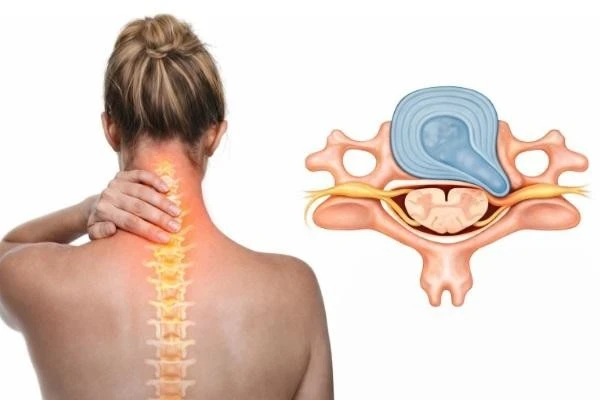
You turn your head and feel a sharp pain in your neck. A few moments later, an uncomfortable sensation travels toward your shoulder or down your arm.
Maybe the pain appears after working at your computer. Perhaps your fingers occasionally tingle, or you have difficulty finding a comfortable sleeping position.
One possible explanation is a cervical herniated disc.
A cervical herniated disc occurs when part of an intervertebral disc extends beyond its normal boundary. In some cases, the displaced disc material irritates or compresses nearby nerves, causing neck pain, arm discomfort, numbness, or weakness.
However, not every herniated disc causes symptoms, and not every episode of neck pain is disc-related.
Understanding the condition can help patients in Charleston make informed decisions about evaluation and treatment.
What Is a Cervical Herniated Disc?
Your cervical spine consists of seven vertebrae, labeled C1 through C7.
Between most of these vertebrae are intervertebral discs that help distribute mechanical loads and allow controlled movement.
Each disc contains two important structures:
Annulus fibrosus: A strong outer ring made of layered connective tissue.
Nucleus pulposus: A softer central structure that helps distribute forces within the disc.
A disc herniation occurs when disc material extends beyond its usual anatomical boundaries, potentially affecting nearby tissues.
If the disc irritates a cervical nerve root, symptoms may travel into the shoulder, arm, or hand.
If a large herniation compresses the spinal cord, more serious neurological problems can develop.
What Causes a Herniated Disc in the Neck?
Several factors can contribute to cervical disc herniation.
Age-Related Disc Changes
Over time, discs may gradually lose hydration and undergo changes in their internal structure.
These changes can make some discs more susceptible to herniation.
Sudden Injuries
Motor vehicle collisions, falls, or other traumatic events may contribute to disc injury.
Not all post-traumatic neck pain involves a herniated disc, so appropriate examination is important.
Repetitive Physical Demands
Repeated loading and certain occupational activities may contribute to cervical discomfort or aggravate existing disc conditions.
However, disc herniation is multifactorial and should not be attributed to one posture or movement without evidence.
Individual Anatomy and Genetics
Genetic and anatomical factors also influence disc degeneration and susceptibility to spinal conditions.
A person may develop a cervical disc herniation without recalling any specific injury.

What Are the Symptoms of a Cervical Herniated Disc?
Symptoms depend on the location of the herniation and whether it affects a nerve root or the spinal cord.
Potential symptoms include:
- Neck pain or stiffness
- Pain radiating into one shoulder or arm
- Tingling in the fingers
- Numbness in part of the hand
- Muscle weakness
- Pain that increases during certain neck movements
- Discomfort during prolonged sitting or driving
Some individuals experience arm symptoms that are more prominent than their neck pain.
Others have a herniated disc visible on MRI but experience no symptoms at all.
For this reason, imaging findings must be interpreted alongside a clinical examination.
Why Can a Herniated Disc Cause Arm Pain?
Cervical nerve roots exit the spine through openings between adjacent vertebrae.
These nerves carry sensory and motor signals to different areas of the shoulder, arm, and hand.
When a herniated disc compresses or irritates a nerve root, the resulting condition is called cervical radiculopathy.
Depending on the affected nerve, symptoms may include pain, tingling, reduced sensation, or weakness in specific muscle groups.
The location of symptoms can provide clues, but symptom patterns often overlap.
An accurate diagnosis requires an examination rather than relying on a single painful area.
Is a Bulging Disc the Same as a Herniated Disc?
Not exactly.
A disc bulge describes a relatively broad extension of disc tissue beyond its usual boundary.
A herniation describes a more localized displacement of disc material.
These findings are related but have different anatomical definitions.
Neither automatically indicates a serious problem.
Some people have disc bulges or herniations without symptoms.
The more important questions are whether neurological structures are affected and whether the imaging findings explain the person's clinical symptoms.
What Is the Connection Between Cervical Discs and the Upper Cervical Spine?
The upper cervical spine consists of the atlas (C1) and axis (C2).

These vertebrae have specialized anatomy that supports the head and allows important movements.
Unlike the lower cervical spine, there is no conventional intervertebral disc between C1 and C2.
Most cervical disc herniations occur lower in the neck, commonly around the C5–C6 and C6–C7 levels.
This distinction matters.
Upper cervical posture or joint mechanics may be relevant to certain neck symptoms, but an atlas misalignment should not be presumed to cause or maintain a lower cervical disc herniation.
Likewise, correcting upper cervical alignment has not been established as a method of physically reversing disc herniation.
A comprehensive examination should consider both the location of the disc abnormality and the patient's symptoms.
Can Upper Cervical Chiropractic Help a Herniated Disc?
Upper cervical chiropractic focuses on evaluating the uppermost cervical joints and their mechanical function.
At Charleston Upper Cervical Chiropractic, Dr. William Youngblood provides individualized corrective spinal care using the Knee Chest Upper Cervical approach.
A consultation may include evaluation of neck movement, posture, previous injuries, and relevant neurological findings.
For patients with a known cervical disc herniation, the first step is determining whether there is nerve root compression, spinal cord involvement, or another reason that a procedure may be unsafe.
A targeted upper cervical intervention may be considered for a separate mechanical neck complaint in appropriately selected patients.
However, there is insufficient high-quality evidence that upper cervical adjustments repair a herniated disc, restore displaced disc tissue, or reliably decompress an affected nerve root.
Patients should receive an explanation of potential risks, expected benefits, and appropriate alternatives.
Progressive neurological symptoms or suspected spinal cord compression require medical evaluation rather than routine cervical manipulation.
What Can You Do at Home?
If a healthcare professional has ruled out serious neurological complications, several strategies may help reduce everyday discomfort.
1. Change positions regularly.
Avoid holding your head and neck in one position for prolonged periods.
2. Adjust your workstation.
Use a screen position that allows comfortable viewing without sustained neck bending.
3. Maintain gentle activity.
Walking and tolerable movement can help prevent unnecessary stiffness and deconditioning.
4. Use appropriate pillow support.
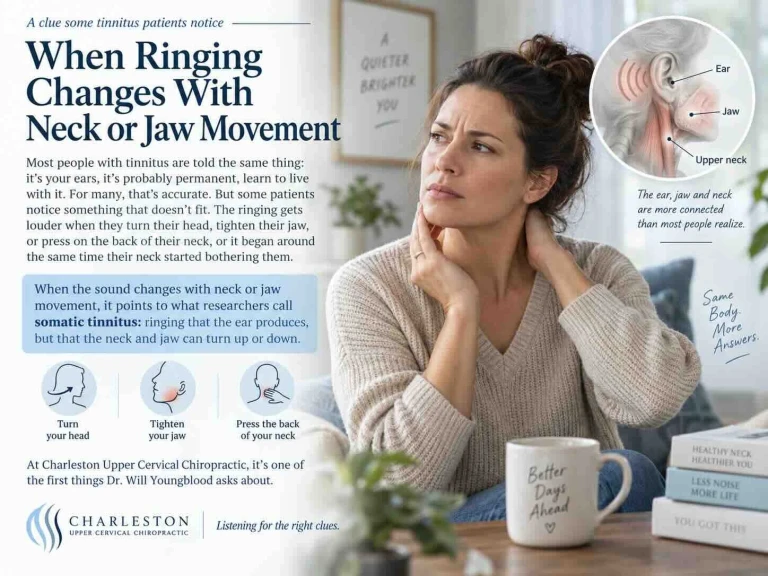
Choose a sleeping position that does not continually aggravate your symptoms.
5. Follow a tailored exercise program.
Exercises should match the diagnosis, severity of symptoms, and individual tolerance.
Avoid aggressive neck stretching, forceful self-manipulation, or activities that noticeably worsen neurological symptoms.
When Is a Herniated Cervical Disc Serious?
A herniated disc may become particularly concerning when it affects the spinal cord.
Possible warning signs include:
- New or worsening arm or leg weakness
- Difficulty walking or maintaining balance
- Loss of hand coordination
- Increasing numbness
- New bowel or bladder control problems
- Rapid neurological deterioration
New bowel or bladder dysfunction, severe progressive weakness, or rapidly worsening neurological symptoms require emergency evaluation.
These findings should not be treated as ordinary neck stiffness.
Frequently Asked Questions
Can a cervical herniated disc heal without surgery?
Many people improve with nonsurgical treatment. In some cases, herniated disc material may decrease in size over time, although the degree of anatomical change varies.
Can a herniated disc cause headaches?
Neck disorders and headaches may coexist, but headaches alone do not confirm a disc herniation. Different headache conditions require separate assessment.
Can a cervical disc herniation cause finger numbness?
Yes. If a herniation irritates a cervical nerve root, it may produce numbness or tingling in parts of the arm or hand. Other nerve conditions can cause similar symptoms.
Will an upper cervical adjustment put a disc back into place?
No. There is no established evidence that upper cervical adjustments physically reposition herniated cervical disc material.
Is it safe to exercise with a cervical herniated disc?
Many patients can remain active with appropriate modifications. Exercise selection should account for pain, neurological findings, and medical recommendations.
When should I see a chiropractor for neck pain?
A chiropractic evaluation may be considered for uncomplicated mechanical neck discomfort after appropriate screening. Significant neurological symptoms or suspected spinal cord compression require medical assessment before manipulation is considered.
Cervical Spine Evaluation in Charleston, SC
A cervical herniated disc can produce symptoms ranging from localized neck discomfort to radiating arm pain and neurological changes.
Understanding the source of these symptoms is essential for choosing appropriate treatment.
At Charleston Upper Cervical Chiropractic, Dr. William Youngblood provides individualized upper cervical assessments focused on spinal mechanics and function.
The practice can evaluate whether a separate mechanical upper cervical complaint may be contributing to a patient's discomfort and identify findings that warrant medical referral.
If ongoing neck discomfort is affecting your daily activities, contact the practice to discuss whether an upper cervical evaluation is appropriate.
Charleston Upper Cervical Chiropractic
1411 Ashley River Road
Charleston, SC 29407
Phone: (843) 225-5855
Medical disclaimer: This article provides general educational information and does not replace individualized diagnosis, medical advice, or specialist treatment. Cervical disc herniation involving the spinal cord or progressive neurological deficits requires appropriate medical evaluation.

Leave a comment