

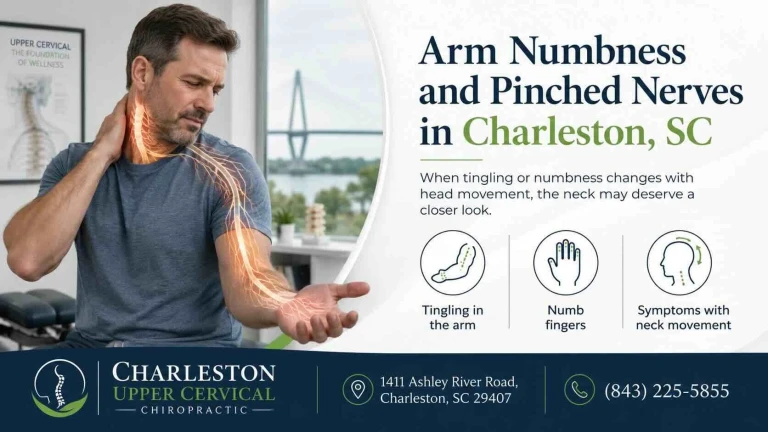
You turn your head while backing out of a parking space.
A strange sensation runs through your shoulder and down your arm.
Maybe it feels like pins and needles. Maybe two fingers go partially numb. You straighten your head and the sensation settles.
A few hours later, it happens again.
At first, you shake your hand and move on.
After a few weeks, however, you start wondering why something happening in your neck seems to be showing up all the way down in your hand.
That pattern can occur with cervical radiculopathy.
When Arm Numbness Starts Higher Up
Cervical radiculopathy occurs when a nerve root in the cervical spine becomes irritated or compressed as it leaves the spinal cord.
The nerve does not end in the neck.
It continues toward the shoulder, arm, hand, and fingers. That means the location where you feel the symptom may be several inches—or several feet—away from the irritated area.
The American Academy of Orthopaedic Surgeons notes that cervical radiculopathy can cause radiating arm or shoulder pain, numbness, tingling, and muscle weakness. Certain neck movements may make the symptoms worse.
That last clue matters.
If repeatedly turning, extending, or tilting your head reproduces the familiar arm symptoms, the cervical spine deserves attention during the examination.
What Does a Pinched Cervical Nerve Feel Like?
The experience varies depending on which nerve root is affected.
Some people have strong neck pain and very little hand numbness. Others barely notice the neck at all and assume the problem must be in the wrist or shoulder.
Common patterns include:

- Burning or sharp pain traveling into the shoulder or arm
- Pins and needles in the hand or fingers
- Areas of reduced sensation
- Weakness while gripping, lifting, or pushing
- Symptoms that change with neck position
These findings do not diagnose cervical radiculopathy by themselves. The clinician also needs to evaluate strength, reflexes, sensation, movement, and the history of the problem.
Why Does It Happen?
In younger adults, a herniated cervical disc can irritate a nerve root.
As people get older, arthritis and degenerative changes may reduce the amount of room available where the nerve exits the spine.
An injury can contribute as well.
A rear-end collision from ten years ago may seem irrelevant—until the patient explains that the arm tingling began after that accident and neck rotation never completely returned to normal.
History gives context to the symptom.
What Recent Research Says
A 2025 randomized study published in NEJM Evidence compared surgical and nonsurgical care in patients with disabling cervical radicular arm pain caused by disc herniation or spondylosis.
The study found that the optimal approach depends partly on the underlying cause. Surgery produced greater improvement in some groups, particularly patients with disc herniation, while cervical radiculopathy remains a condition that is often initially managed conservatively when serious neurological deficits are not present.
That is an important point for chiropractic patients.
Not every numb arm needs surgery.
But not every numb arm simply needs an adjustment either.
The job of a careful examination is to determine which category the patient appears to be in.
Why an Upper Cervical Chiropractor Looks Beyond the Painful Spot
Charleston Upper Cervical focuses on the relationship of the skull, atlas, axis, and the rest of the spine.
A problem at C1 or C2 is not the same thing as lower cervical nerve-root compression. Most cervical nerve roots involved in classic arm radiculopathy exit lower in the cervical spine.

So why examine the upper cervical region?
Because the head and upper cervical spine can influence how the rest of the neck compensates mechanically.
If head position is persistently shifted, lower cervical muscles and joints may adapt around that position. That does not prove C1 caused the radiculopathy. It means the entire cervical system should be evaluated rather than treating one painful segment in isolation.
Charleston Upper Cervical describes its approach as Corrective Spinal Care and uses focused upper cervical analysis rather than routine generalized manipulation.
Is It Really Coming From the Neck?
Sometimes it is not.
Carpal tunnel syndrome can produce numbness in the thumb, index, and middle fingers.
Ulnar nerve compression commonly affects the ring and little fingers.
Shoulder disorders can refer pain down the arm.
Diabetes and other peripheral neuropathies can also produce altered sensation.
This is why “my hand is numb” is the beginning of the evaluation, not the diagnosis.
One useful question is whether neck movement reliably changes the symptom.
Another is whether weakness is developing.
When Weakness Matters
Tingling is uncomfortable.
Progressive weakness is more concerning.
If you are suddenly dropping objects, losing grip strength, struggling to lift the arm, or noticing that one muscle group is clearly weaker than the other side, neurological evaluation becomes more important.
Likewise, numbness affecting both arms along with walking difficulty, poor balance, or loss of hand dexterity may indicate spinal cord involvement rather than an isolated nerve root.

Those symptoms should not be managed as routine stiffness.
What an Evaluation May Include
A focused examination may look at cervical range of motion, reflexes, muscle strength, sensation, previous injuries, shoulder function, and the positions that reproduce the symptoms.
Imaging may be appropriate when trauma, significant neurological deficits, worsening weakness, or other concerning findings are present.
The important part is that the care plan follows the examination—not the other way around.
Frequently Asked Questions
1. Can a pinched nerve cause numb fingers?
Yes. Cervical nerve-root irritation can produce numbness or tingling into specific parts of the arm, hand, or fingers.
2. Why does turning my head make my arm tingle?
Certain neck positions can reduce the space around an already irritated cervical nerve root. Reproducible symptoms with neck movement are a useful clinical clue.
3. Can I have cervical radiculopathy without severe neck pain?
Yes. Some patients notice arm symptoms much more than neck pain.
4. Does upper cervical chiropractic cure a pinched nerve?
No treatment should be promised as a cure. Upper cervical evaluation may identify mechanical factors contributing to cervical compensation, while disc herniation, arthritis, significant nerve compression, or progressive weakness may require other treatment.
Arm Numbness Evaluation in Charleston, SC
It is easy to chase the place that tingles.
Massage the forearm.
Stretch the hand.
Buy a wrist brace.
Sometimes that is exactly where the problem is.
But if the numbness consistently changes when your head moves, it may be worth looking farther up the nerve pathway.
Charleston Upper Cervical Chiropractic
1411 Ashley River Road
Charleston, SC 29407
Phone: (843) 225-5855
Dr. Will Youngblood provides focused upper cervical evaluation for patients throughout Charleston, West Ashley, James Island, Mount Pleasant, North Charleston, Summerville, and surrounding Lowcountry communities.
Medical note: Progressive weakness, severe trauma, widespread numbness, walking difficulty, or loss of hand coordination requires appropriate medical evaluation.

Leave a comment