

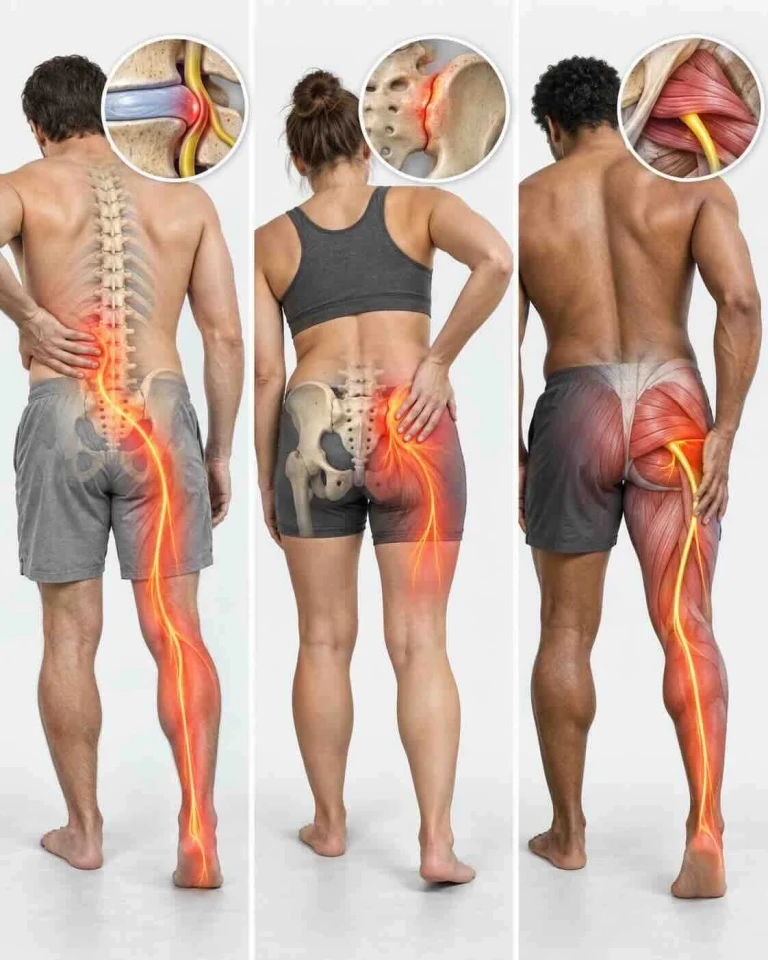
Sciatica may be the most overused word in musculoskeletal care. Patients apply it to nearly any pain running from the low back or buttock into the leg, yet true sciatica, irritation of a lumbar nerve root, is only one of three common culprits, alongside the sacroiliac joint and the piriformis muscle.
Distinguishing them matters because each responds to different care. But there is a second question that matters just as much and gets asked far less often: what do all three suspects have in common?
At Charleston Upper Cervical Chiropractic in West Ashley, Dr. Will Youngblood's answer frequently sits at the opposite end of the spine, in the alignment of the top two vertebrae of the neck.
What Are the Three Common Sources of Sciatica Symptoms?
True sciatica, technically lumbar radiculopathy, comes from a compressed or chemically irritated nerve root, most often at the L4-L5 or L5-S1 disc. Its hallmark is precision: nerve roots supply defined strips of the leg, so the pain follows a traceable line, frequently below the knee. An S1 root sends symptoms down the back of the leg to the heel, with a fading ankle reflex. An L5 root wraps the outer leg onto the top of the foot and big toe, with weak toe lift as its signature.
Sacroiliac joint dysfunction refers pain into the buttock and sometimes the back of the thigh, but it stays broad, resists tracing, rarely passes the knee, and flares with transitional movements: standing from a chair, rolling over in bed, stepping out of the car after the drive in from Summerville.
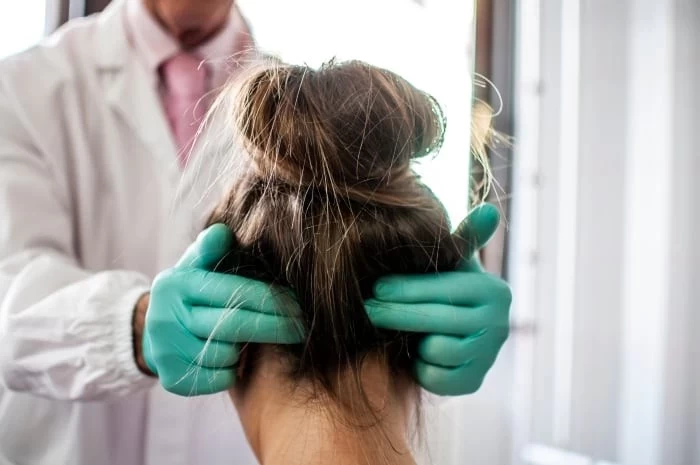
Piriformis syndrome comes from a deep buttock muscle that crosses directly over the sciatic nerve, and in some people the nerve pierces the muscle itself. When the piriformis tightens or spasms, it squeezes the nerve, mimicking disc-driven sciatica. Its tells: prolonged sitting makes it worse, the low back itself feels fine, and deep pressure into the buttock reproduces the pain.
What Do a Disc, the SI Joint, and the Piriformis Have in Common?
All three live in or around the pelvis, and all three are exquisitely sensitive to whether that pelvis sits level. This is where the upper neck enters the story.
The nervous system enforces one postural rule above all others: the head stays level. The atlas (C1) and axis (C2) carry the skull at the top of the spinal chain with no discs interlocking them, held by muscles and ligaments alone.
When trauma shifts them, a car accident, a sports hit, a hard fall, the head tilts slightly off center, and the body refuses to leave it there. It compensates downward instead: the spine curves subtly, the shoulders unlevel, and the pelvis rotates and tips to bring the eyes back to the horizon.
Now look at what a tipped, rotated pelvis does to each of the three suspects. The sacroiliac joints, the very joints connecting spine to pelvis, are forced to operate in a twisted position day after day, which is precisely the mechanical stress that inflames them.

The piriformis, anchored from the sacrum to the hip, is stretched or shortened on one side by the rotation, and a muscle held at the wrong length chronically tightens over the nerve beneath it. And the lumbar discs stop sharing load evenly, wearing faster on one side until the wall weakens where the L5 or S1 root waits.
Three different diagnoses, one upstream distortion. This is why some patients cycle through disc care, SI injections, and piriformis stretching, each helping briefly, while the pattern keeps reasserting itself.
How Does an Upper Cervical Exam Approach Leg Pain?
By testing the suspects and the structure above them. Dr. Youngblood examines the leg by nerve root: strength, reflexes at the knee and ankle, sensation mapping, and the straight-leg raise. SI provocation tests and targeted palpation of the piriformis sort the non-root candidates. Then the analysis moves to where general leg pain exams stop: precise assessment of how the atlas and axis sit under the skull, and how the body is compensating below, including the pelvic unleveling and functional leg length difference that upper cervical doctors verify before and after care.
Dr. Youngblood is a graduate of the inaugural Upper Cervical Academy class through Sherman College of Chiropractic and holds advanced certification in the Knee Chest technique, a precise, upper-cervical-specific method he now teaches to chiropractic students and doctors.
The correction is specific to each patient's measured misalignment, and the logic is structural: restore the head-neck relationship at the top, and the compensations that have been grinding on the SI joints, the piriformis, and the lumbar discs are finally free to unwind. Patients from James Island and Mount Pleasant are often surprised that a leg pain evaluation begins at the neck, until they see their own posture findings line up from atlas to pelvis.
When Is Leg Pain Beyond Any Chiropractor's Scope?
Two presentations go straight to the emergency room. Numbness in the groin or inner thighs paired with any new bladder or bowel change can signal cauda equina syndrome, compression of the nerve bundle at the base of the spine. Rapidly progressing leg weakness carries the same urgency. Part of specific chiropractic is knowing what is not chiropractic, and when findings point that direction, the referral happens the same day.
Two Details to Bring to Your Evaluation
First, the map: does your pain follow a line you could draw with a marker, and does it cross the knee? A traceable below-the-knee line leans toward a nerve root; a broad above-the-knee ache leans toward the SI joint or piriformis.
Second, the history: any old whiplash, concussion, or hard fall, even years before the leg ever hurt. The first detail names the suspect.
The second often explains it. Bring both to Dr. Will Youngblood at Charleston Upper Cervical Chiropractic, 811 St Andrews Blvd #A, Charleston, SC 29407, or call (843) 225-5855.

Leave a comment