

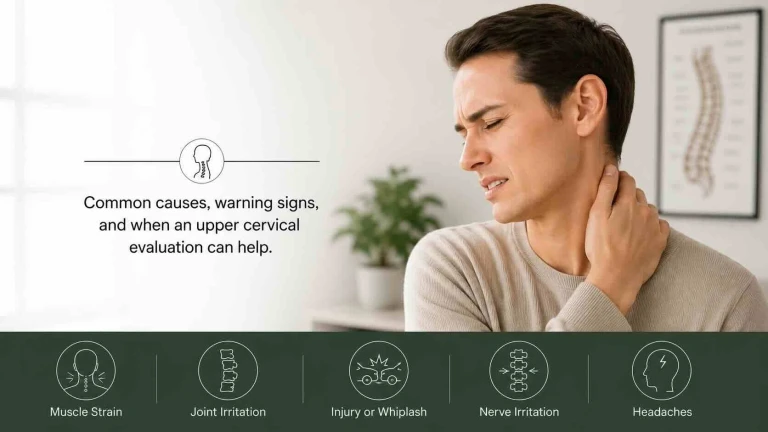
You begin backing out of a parking space and turn to look over your shoulder. A sharp pain catches in your neck.
Maybe it happens while checking traffic. Maybe your neck feels locked when you wake up. Sometimes the pain stays close to the base of the skull. Other times it spreads into the shoulder, upper back, or side of the head.
Neck pain when turning your head is common, but the reason is not always obvious.
The Direct Answer
Pain during neck rotation may come from a strained muscle, an irritated joint, arthritis, poor posture, an old injury, or a cervical nerve problem. When the pain keeps returning, limits your movement, or occurs with headaches and uneven posture, the upper cervical region may deserve a closer evaluation.
The goal is not to guess from the symptom alone. It is to identify which tissues are involved and rule out anything that requires medical attention.
Common Reasons Your Neck Hurts When You Turn It
The neck contains small joints, discs, ligaments, muscles, nerves, and seven cervical vertebrae. All of those structures must work together whenever you turn your head.
Common causes of painful rotation include:
Muscle strain
A muscle can become irritated after sleeping in an awkward position, lifting something unexpectedly, working at a computer, or spending too much time looking down at a phone.
Muscle pain often feels tight, sore, or pulling. It may improve after the neck warms up, although more severe strains can remain painful for days.
Joint irritation
Small facet joints guide movement between the vertebrae. If one becomes irritated or does not move normally, turning toward one side may produce a sharp, localized catch.
Joint-related pain can be more noticeable after a long period of stillness, such as first thing in the morning.
Age-related changes
Cervical spondylosis is the medical term for age-related wear affecting the discs and joints of the neck. It may cause stiffness, reduced motion, grinding sensations, headaches, or pain that spreads into the shoulder or arm.
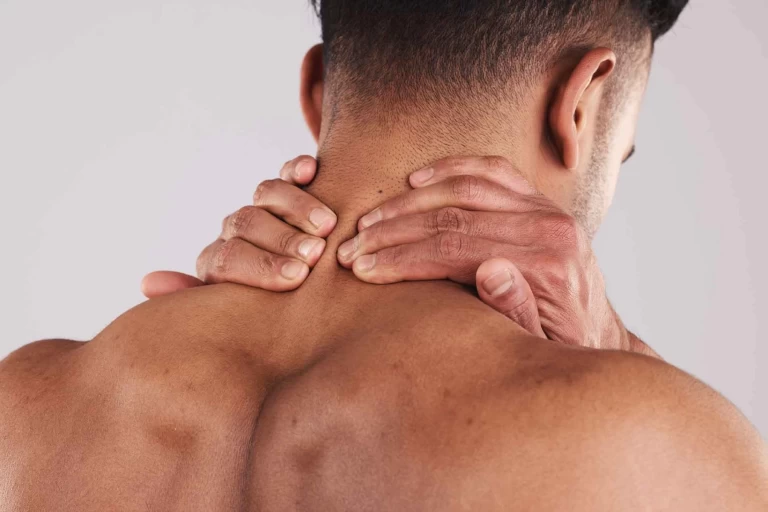
These changes become more common with age, but an imaging finding does not automatically explain a person’s pain. The examination still matters.
Whiplash or an older injury
A car accident, sports collision, fall, or other sudden movement can strain the muscles and ligaments of the neck. Whiplash symptoms do not always begin at the moment of impact. Pain, stiffness, headaches, dizziness, and reduced movement may appear during the following hours or days.
Some patients barely remember the original injury. Years later, however, the neck still turns more easily in one direction than the other.
Nerve irritation
Pain that travels into the shoulder, arm, hand, or fingers may indicate irritation of a cervical nerve root. Numbness, tingling, altered reflexes, or weakness make a neurological examination especially important.
Why the Upper Neck Can Affect Rotation
The atlas and axis, also called C1 and C2, form the uppermost part of the cervical spine. Their structure is different from the vertebrae below them, and they contribute substantially to head positioning and rotation.
When the upper neck becomes mechanically irritated, the surrounding muscles may tighten to protect the area. A person may then begin turning through the lower neck or shoulders instead of moving smoothly through the entire cervical spine.
This compensation can create a familiar pattern:
- One direction feels blocked.
- The head sits slightly tilted or rotated.
- One shoulder rests higher.
- Tightness returns soon after stretching.
- Headaches begin near the base of the skull.
- Driving or looking over the shoulder becomes difficult.
These signs do not prove that C1 or C2 is the source. They indicate that a focused examination may be useful.
When Neck Pain Requires Prompt Medical Attention
Most neck pain is musculoskeletal, but certain combinations of symptoms should not be managed as an ordinary stiff neck.
Seek urgent medical care when neck pain follows a serious collision, fall, or diving injury, or when it occurs with:
- New arm or leg weakness
- Difficulty walking
- Loss of coordination
- Fever and severe stiffness
- Trouble speaking
- Facial drooping
- Sudden vision changes
- Loss of bladder or bowel control
- A sudden, unusually severe headache
Severe pain after trauma, progressive weakness, and trouble walking can indicate a more serious neurological or spinal condition.
What an Upper Cervical Evaluation May Include
An upper cervical visit should involve more than asking where it hurts and immediately adjusting the neck.
A thoughtful evaluation may include:
- A history of previous accidents, falls, sports injuries, and concussions
- Observation of head and shoulder position
- Active neck range-of-motion testing
- Orthopedic and neurological screening
- Muscle and joint examination
- Assessment of body symmetry and compensation
- Imaging when clinically appropriate
The doctor should also determine whether your presentation falls within the scope of chiropractic care. Referral for medical imaging or evaluation may be necessary when the examination reveals neurological deficits, significant trauma, vascular concerns, or another suspected condition.
Charleston Upper Cervical describes its approach as corrective spinal care focused on neurostructural abnormalities rather than simply masking symptoms.
Does an Upper Cervical Adjustment Involve Twisting?
Upper cervical techniques are generally designed to be focused and controlled. The exact method depends on the practitioner, examination findings, patient history, bone health, and the technique being used.
A correction should never be based only on the assumption that every painful neck is “out.”
Some visits may involve an adjustment. Others may involve reassessment without another correction when the doctor believes the area is stable. The purpose is to use the least intervention reasonably needed, not to create as much motion or sound as possible.
What You Can Do at Home
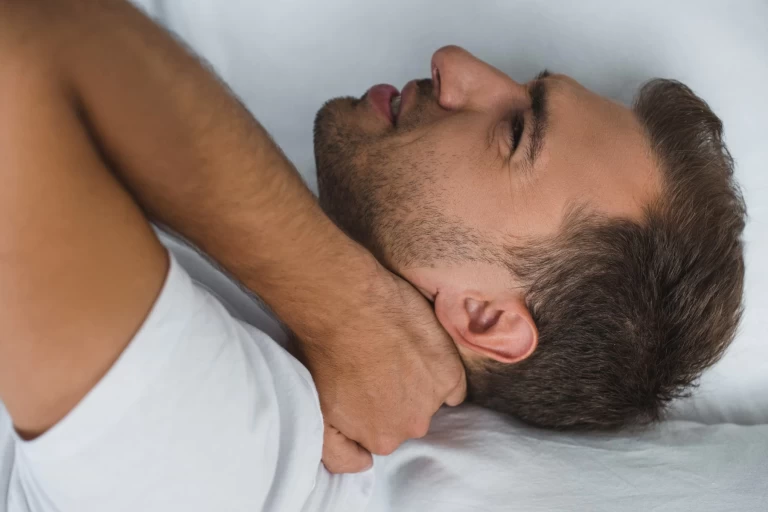
For mild neck discomfort without warning signs, a few simple changes may help:
Keep screens close to eye level. Avoid holding your head forward for long stretches. Take movement breaks during desk work, and do not force your neck through a sharp or blocked range.
Your sleep position matters as well. A pillow should support the neck without pushing the head sharply upward or allowing it to collapse toward the mattress. Mayo Clinic recommends keeping the head and neck aligned with the rest of the body during sleep.
Avoid repeatedly cracking or forcefully twisting a painful neck. That may briefly change the sensation without identifying why the restriction keeps returning.
Frequently Asked Questions
1. Why does my neck hurt on only one side when I turn?
One-sided pain may involve a muscle strain, an irritated cervical joint, protective muscle spasm, or nerve irritation. An examination is needed when the problem persists or repeatedly returns.
2. Can neck pain cause a headache?
Yes. Certain headaches originate from structures in the cervical spine and refer pain into the back, side, or front of the head. Headaches may also have migraine, vascular, medication-related, infectious, or other causes.
3. Should I stretch a neck that feels locked?
Gentle, pain-free movement may be reasonable for an uncomplicated stiff neck. Do not force through sharp pain, dizziness, numbness, weakness, or a hard mechanical stop.
4. When should I schedule an evaluation?
Consider an evaluation when pain lasts more than several days, repeatedly returns, restricts driving or work, follows an injury, or occurs with headaches, dizziness, arm symptoms, or visible postural imbalance.
Neck Pain Evaluation in Charleston, SC
Living with restricted neck movement quietly changes the way you do ordinary things. You rotate your whole body when driving. You avoid certain sleeping positions. You stop looking over one shoulder because you know what will happen.
That adaptation may get you through the day, but it does not explain the cause.
Charleston Upper Cervical Chiropractic is located at 1411 Ashley River Road in Charleston, South Carolina, serving patients from Charleston, West Ashley, James Island, Mount Pleasant, North Charleston, Summerville, and surrounding communities.
A focused evaluation can help determine whether your painful neck rotation involves an upper cervical mechanical problem, a different musculoskeletal condition, or findings that need medical referral.
Call (843) 225-5855 to request an appointment.

Leave a comment