

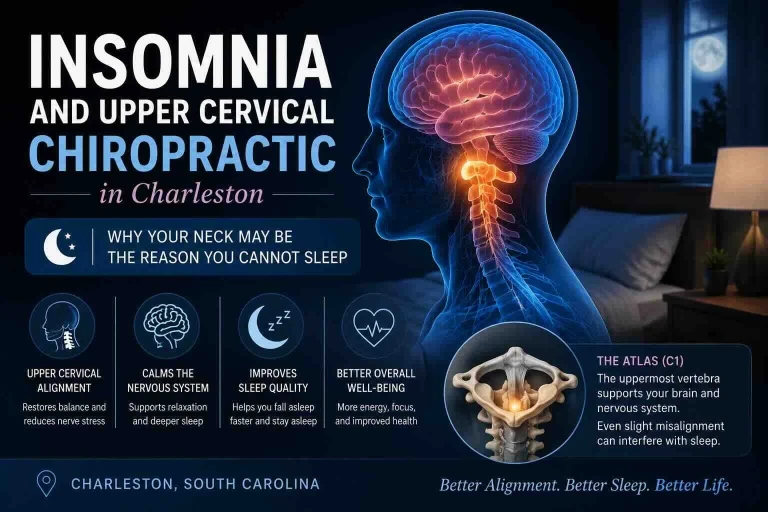
You lie down tired. Your body wants sleep. But your brain will not shut off. The ceiling becomes your most familiar view. Hours pass. Eventually you either fall into a shallow, unsatisfying rest or the alarm goes off and you start another day running on fumes.
If this pattern has become your normal, you are not alone. And the reason it keeps happening may have nothing to do with stress, screen time, or your mattress. It may be structural. It may be at the very top of your neck.
What Insomnia Actually Is
Insomnia is a sleep disorder defined by persistent difficulty falling asleep, staying asleep, or waking too early and being unable to return to sleep. It affects an estimated 50 to 70 million adults in the United States. About 30% of the general population reports symptoms of insomnia, and roughly 10% have chronic insomnia severe enough to affect daytime functioning.
The effects extend far beyond tiredness. Chronic sleep deprivation impairs cognitive function, weakens the immune system, raises blood pressure, increases the risk of cardiovascular disease and diabetes, and accelerates the aging process at a cellular level.
Depression, anxiety, and irritability frequently accompany long-standing insomnia, creating a cycle where poor sleep feeds emotional disturbance, which feeds poorer sleep.
The standard medical approach typically involves sleep hygiene counseling, cognitive behavioral therapy for insomnia (CBT-I), and medication. Prescription sleep aids like zolpidem and eszopiclone can help in the short term, but they carry risks of dependency, cognitive dulling, and rebound insomnia when discontinued. Over-the-counter options like diphenhydramine and melatonin supplements provide mild support but rarely resolve chronic insomnia.
What none of these approaches addresses is the possibility that the brain's sleep regulation hardware is being physically interfered with by a structural misalignment in the spine.
The Three Mechanisms That Connect Your Neck to Your Sleep

Sleep is not passive. It is an actively regulated neurological event. The brain must shift from waking mode to sleep mode through a coordinated sequence involving specific brainstem structures, hormonal signals, and autonomic nervous system transitions. The atlas vertebra (C1) sits at the junction where all three of these systems converge. When it is misaligned, each one can be disrupted.
Mechanism one: the reticular activating system. The reticular activating system (RAS) is a network of neurons located in the brainstem that governs wakefulness and the transition into sleep. When the RAS is active, you are alert. When it ramps down, the brain shifts into progressively deeper sleep stages.
The RAS sits in the midbrain, pons, and medulla, the regions directly above and adjacent to the atlas. Mechanical irritation at the craniocervical junction can keep the RAS in a state of low-level activation, making it physiologically harder for the brain to "turn off" at night. Patients often describe this as being tired but wired, exhausted yet unable to cross the threshold into sleep.
Mechanism two: the melatonin pathway. Melatonin is the hormone that signals the brain and body to prepare for sleep. It is produced by the pineal gland, and the pineal gland receives its nerve supply from the superior cervical ganglion (SCG).
The SCG is a cluster of sympathetic neurons that sits directly along the front of the C1 through C4 vertebral bodies and transverse processes. When the atlas is displaced, it can alter the mechanical environment around the SCG, disrupting the sympathetic signaling that controls the timing and volume of melatonin release. The result is a circadian rhythm that feels broken: you are not sleepy when you should be, or you are sleepy at the wrong times.
Mechanism three: autonomic nervous system transition. Falling asleep requires the autonomic nervous system to shift from sympathetic dominance (alertness, arousal) to parasympathetic dominance (relaxation, recovery). The vagus nerve, the primary parasympathetic carrier, exits the skull immediately adjacent to the atlas. The brainstem nuclei that regulate vagal tone sit directly above it.
An atlas misalignment that irritates these structures can impair the body's ability to make the sympathetic-to-parasympathetic switch, leaving the nervous system stuck in a state that is incompatible with restful sleep.
No single competing explanation for insomnia captures all three of these pathways. But they all converge at the same anatomical location: the craniocervical junction.

Why Sleep Medications Cannot Fix a Structural Problem
Sleep medications work by chemically sedating the brain or boosting specific neurotransmitters like GABA. They can force the brain past the waking threshold. But they do not address the reason the threshold was elevated in the first place.
If the RAS is being held in a state of partial activation by brainstem irritation, if melatonin production is disrupted by SCG interference, and if the autonomic nervous system cannot transition because vagal tone is impaired, then medication is overriding a system that is structurally compromised.
This is why many insomnia patients report that sleep medications stop working over time, or that the sleep they get on medication does not feel restorative. The architecture of sleep, the cycling through light sleep, deep sleep, and REM stages, depends on brainstem regulation that medication does not restore.
Knee Chest Upper Cervical Care for Insomnia at Charleston Upper Cervical
Dr. Will Youngblood at Charleston Upper Cervical Chiropractic specialize in Corrective Spinal Care using the Knee Chest Upper Cervical technique.
Dr. Youngblood is advanced certified through the Knee Chest Society and serves as an instructor teaching the technique to chiropractic students and doctors worldwide.
The evaluation begins with a thorough history that includes detailed questions about sleep patterns, symptom onset, and injury history. Precision three-dimensional X-ray analysis determines exactly how the atlas and axis have shifted relative to the base of the skull.
Video X-ray (motion study) analysis identifies areas of the spine that have lost normal movement due to compensatory locking. Computerized thermography measures temperature differentials along the spine that reflect nervous system function.

From this data, the doctors determine whether a Neurostructural abnormality exists at the craniocervical junction and, if so, the precise correction needed. The Knee Chest adjustment is specific, controlled, and delivered with only the amount of pressure used to palpate a pulse. There is no cracking, no twisting, and no generalized manipulation. The goal is precision with the least intervention possible.
Patients are monitored at each visit. If the atlas is holding its corrected position, no adjustment is made. This is not about repeated treatment. It is about a stable structural correction that lets the brainstem, the SCG, and the vagus nerve function without interference so the body's sleep systems can self-regulate.
What Patients Notice
Sleep changes tend to be among the earliest improvements patients report after upper cervical correction. For some, the change is dramatic: falling asleep within minutes instead of hours. For others, it is more gradual: sleep becomes deeper, more continuous, less fragmented. Morning grogginess lifts. The need for sleep medication decreases. Energy during the day stabilizes.
Some patients notice changes they were not expecting alongside the sleep improvement: reduced neck tension, fewer headaches, better digestion, improved mood. These are not coincidental. They are all functions regulated by the same brainstem and autonomic pathways that were being structurally compromised.
Who Should Consider an Upper Cervical Evaluation
If you are in Charleston, West Ashley, St Andrews, James Island, Mt Pleasant, Summerville, Johns Island, or North Charleston and you have been dealing with insomnia that sleep hygiene, supplements, and medication have not resolved, the upper cervical spine may be the factor that nobody has examined.
This is especially worth pursuing if your sleep problems started after a car accident, a fall, a concussion, or another injury to the head or neck, or if you also experience neck stiffness, headaches, or a sense that your nervous system runs "too hot" even when life is calm.
Charleston Upper Cervical Chiropractic offers a complimentary 15-minute phone consultation to discuss your situation before committing to anything.
The office is at 1411 Ashley River Road, Charleston, SC 29407. Call (843) 225-5855.



Leave a comment