

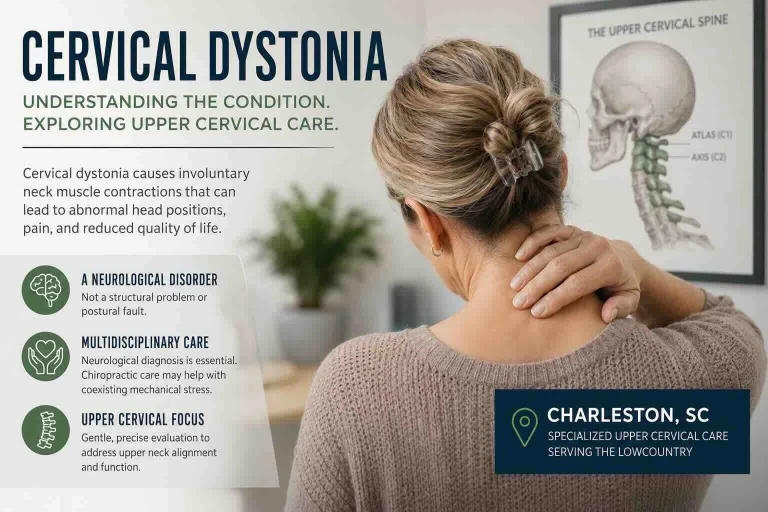
Your neck turns when you are trying to hold it still. One shoulder begins to rise. Your head pulls, tilts, or twists to one side, and forcing it back to center only increases the tension.
At first, it may feel like a stubborn muscle spasm. Then the pattern keeps returning.
Cervical dystonia, also called spasmodic torticollis, is a neurological movement disorder that causes involuntary contractions in the neck muscles. Those contractions can pull the head forward, backward, sideways, or into rotation. Many people also experience neck pain, headaches, tremor, fatigue, and difficulty with daily activities.
The direct answer is this: cervical dystonia requires medical diagnosis and is usually managed by a neurologist or movement-disorder specialist. Upper cervical chiropractic does not replace that care. A careful evaluation may, however, identify mechanical neck stress or compensatory posture occurring alongside the neurological condition.
What Is Cervical Dystonia?
Dystonia occurs when the nervous system produces abnormal, involuntary muscle contractions. When it primarily affects the head and neck, it is called cervical dystonia. The contractions may be sustained or intermittent.
Common movement patterns include:
- Torticollis: the head rotates to one side
- Laterocollis: the head tilts toward one shoulder
- Anterocollis: the head pulls forward
- Retrocollis: the head pulls backward
Some patients experience a combination of movements or develop head tremor. Pain is common and can become as limiting as the movement itself.
Cervical dystonia is not simply poor posture, a tight trapezius, or a joint that needs to be “put back.” It is a neurological disorder. That distinction shapes the examination and treatment plan.
What Does Cervical Dystonia Feel Like?
Symptoms may begin gradually and become more noticeable during stress, fatigue, walking, driving, or tasks requiring the head to remain in one position.
Patients may notice repeated pulling of the head, pain at the base of the skull or shoulder, one shoulder sitting higher, jerking movements, difficulty looking straight ahead, or temporary relief when touching the face or chin.
That final response is called a sensory trick, or geste antagoniste. A light touch may briefly reduce the abnormal movement without correcting the disorder. Fatigue and stress can also make dystonic movements more noticeable.
The effects can reach beyond the neck. Research has found that pain, disability, sleep problems, anxiety, and depression can significantly affect quality of life in people with cervical dystonia.
How Is Cervical Dystonia Diagnosed?
There is no single blood test or routine X-ray that confirms cervical dystonia. Diagnosis is based mainly on the patient’s history and a neurological examination.
A neurologist may evaluate the direction of the movement, the muscles involved, the presence of tremor, medication history, previous injuries, and signs of another neurological condition. Imaging or laboratory testing may be ordered when another potential cause needs to be excluded.
Sudden neck twisting after starting or changing a medication may represent an acute dystonic reaction rather than gradually developing cervical dystonia. These reactions can occur after exposure to certain dopamine-blocking medications, including some antipsychotic and anti-nausea drugs.
New neck spasms accompanied by trouble breathing, swallowing, or speaking require immediate medical attention.
What Is the Standard Treatment for Cervical Dystonia?
Botulinum neurotoxin injections are considered first-line treatment for most adults with cervical dystonia. The medication is injected into selected overactive muscles to reduce contraction, abnormal head position, and pain. The FDA has approved botulinum toxin products specifically to reduce abnormal head position and neck pain associated with cervical dystonia.
Treatment may also include oral medication, physical or occupational therapy, and strategies that make driving, working, sleeping, and other daily activities more manageable.
Deep brain stimulation may be considered in severe cases that have not responded adequately to conservative medical treatment. Because every movement pattern is different, treatment depends on identifying the correct muscles and adjusting the plan over time.
Where Can Upper Cervical Chiropractic Fit?
The atlas and axis—the C1 and C2 vertebrae—sit directly beneath the skull and help support and guide head movement.
When the head is repeatedly pulled into an abnormal position, the joints, muscles, and soft tissues of the upper neck may experience uneven mechanical stress. Previous whiplash, concussion, or another neck injury may add another structural issue that deserves evaluation. Trauma can be associated with some cases of secondary cervical dystonia, although many patients develop the condition without a clearly identifiable injury.
An upper cervical chiropractor can evaluate joint motion, posture, alignment, and compensatory strain. The purpose is not to diagnose or cure the neurological disorder. It is to determine whether a separate mechanical problem may be contributing to pain, stiffness, headaches, or reduced movement.
Any chiropractic care for a patient with cervical dystonia should be gentle, individualized, and coordinated with the patient’s medical team. Forceful neck manipulation is not a substitute for neurological care. The patient’s movement pattern, bone health, vascular risk, medications, previous imaging, and ability to hold the head safely must all be considered.
What Happens at Charleston Upper Cervical Chiropractic?
Charleston Upper Cervical Chiropractic describes its approach as Corrective Spinal Care focused on the upper cervical region.
The practice uses the Knee Chest Upper Cervical technique, detailed health history, precision three-dimensional X-ray analysis, motion studies, and neurological measurements to determine whether a neurostructural abnormality is present.
The correction is designed to be specific and controlled, without generalized twisting or cracking. The office also monitors whether the correction holds rather than automatically adjusting the patient at every appointment.
For someone with cervical dystonia, the better question is not:
“Can you make the spasms disappear?”
It is:
“Is a mechanical upper-neck problem adding to the pain and compensation, and can it be addressed safely alongside neurological treatment?”
Frequently Asked Questions
1. Can a chiropractor cure cervical dystonia?
Current evidence does not establish chiropractic care as a cure or first-line treatment for cervical dystonia. The condition should be evaluated by a neurologist or movement-disorder specialist. Chiropractic care may have a complementary role when mechanical neck pain, joint restriction, or postural compensation is also present.
2. Is cervical dystonia the same as a stiff neck?
No. A stiff neck usually involves temporary muscle or joint irritation. Cervical dystonia causes involuntary, patterned movement or abnormal posture generated by the nervous system.
3. Can cervical dystonia begin after a neck injury?
Some patients report symptoms following trauma, but cervical dystonia can also develop without a clear injury. A clinician must evaluate the timing and rule out other causes rather than assuming the injury explains every symptom.
4. Who should evaluate involuntary neck movement in Charleston?
Start with a primary-care clinician or neurologist, preferably one experienced in movement disorders. After a medical diagnosis has been established, an upper cervical chiropractor may evaluate coexisting mechanical or structural issues when appropriate.
A More Complete Look at the Neck
Cervical dystonia requires a neurological diagnosis, but it may also create substantial mechanical stress through the upper neck and shoulders.
Looking at both sides of the problem can help patients avoid two common mistakes: treating every neck symptom as purely structural or assuming that mechanical stress does not matter simply because the primary diagnosis is neurological.
Charleston Upper Cervical Chiropractic is located at 1411 Ashley River Road in Charleston, South Carolina, serving patients from West Ashley, James Island, Johns Island, Mount Pleasant, North Charleston, Summerville, and nearby Lowcountry communities.
To ask whether a gentle upper cervical evaluation may be appropriate as one part of coordinated care,
call (843) 225-5855.

Leave a comment