

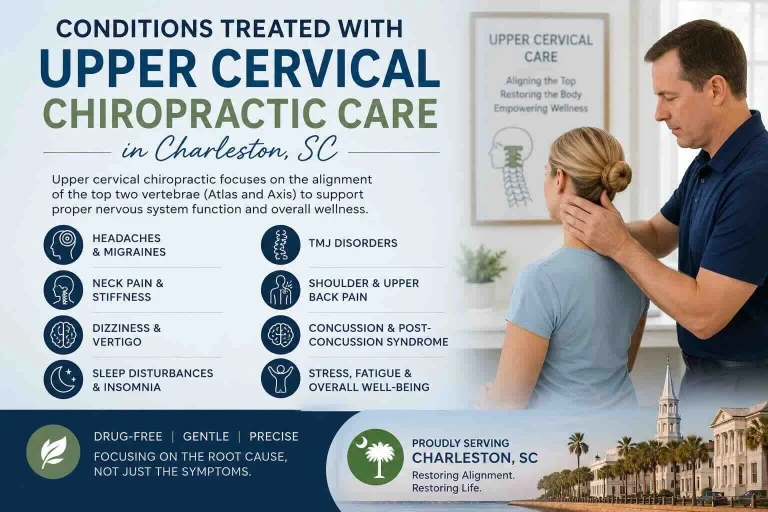
There is a small but critical region at the top of your spine — two vertebrae called the atlas (C1) and axis (C2) — that most people never think about until something goes wrong.
When those vertebrae shift out of alignment, even slightly, the effects can ripple through your entire nervous system. Headaches that won't quit. Vertigo that appears out of nowhere. Neck pain that no amount of stretching seems to fix.
Upper cervical chiropractic care focuses exclusively on this region. It is one of the most precise, research-supported specialties within chiropractic medicine, and for patients in Charleston, SC, it is increasingly becoming a first call rather than a last resort.
What Is Upper Cervical Chiropractic Care?
Upper cervical chiropractic is not the same as general chiropractic. There is no twisting, no cracking, no aggressive manipulation. Instead, practitioners use detailed imaging — typically digital X-rays or cone-beam CT scans — to measure the exact degree of misalignment in the atlas and axis vertebrae. Corrections are gentle, specific, and measured in fractions of a millimeter.
The atlas sits directly beneath the skull and surrounds the brainstem. When it shifts, it can interfere with the signals your brain sends to every organ, muscle, and system in your body. That is why upper cervical misalignment can show up as symptoms that seem completely unrelated to your neck.
Conditions Commonly Treated at Charleston Upper Cervical Chiropractic
Chronic Migraines and Tension Headaches
Migraines are one of the most common reasons patients in Charleston seek upper cervical care. Research published in the Journal of Upper Cervical Chiropractic Research has found a consistent link between atlas misalignment and chronic migraine patterns.
When the atlas compresses surrounding nerves and disrupts blood flow through the vertebral arteries, it can trigger the neurological cascade behind a migraine.

Patients who have tried medication, elimination diets, and lifestyle changes without lasting results often find that addressing the structural root cause changes everything.
Vertigo and Meniere's Disease
Vertigo is disorienting, sometimes debilitating, and frequently misunderstood. The most common type, benign paroxysmal positional vertigo (BPPV), is often linked to fluid drainage issues in the inner ear. The upper cervical spine plays a direct role in that drainage through its influence on the Eustachian tubes and surrounding musculature.
A 2006 case series published by Dr. Michael Burcon found that 97% of Meniere's disease patients had a history of whiplash or head trauma prior to their diagnosis — and that upper cervical correction produced significant improvement in the majority of cases. That study remains one of the most-cited pieces of evidence in this specialty.
For Charleston residents dealing with unexplained dizziness, this connection is worth understanding before accepting a lifelong medication regimen.
Neck Pain and Whiplash
Charleston's roadways, including I-26 and US-17, see their share of rear-end collisions. Whiplash injuries are common, underestimated, and frequently undertreated. Standard care often addresses muscle inflammation without ever evaluating whether the atlas or axis was displaced by the impact.
Upper cervical chiropractic corrects that displacement directly. Patients at 1411 Ashley River Road often come in weeks or months after an accident, still in pain, still told their imaging is "normal" — because standard MRI and X-ray protocols are not calibrated to detect the precise misalignments upper cervical care targets.
Fibromyalgia
Fibromyalgia is one of the more complex conditions seen in upper cervical practice. The widespread pain, fatigue, and cognitive fog associated with fibromyalgia have multiple contributing factors, but central sensitization — an amplified pain response originating in the nervous system — is central to all of them.

Because the atlas directly influences brainstem function, a misalignment here can contribute to or worsen central sensitization.
Several published case studies have documented significant symptom reduction in fibromyalgia patients following upper cervical correction, particularly in pain intensity and sleep quality.
Sciatica and Lower Back Pain
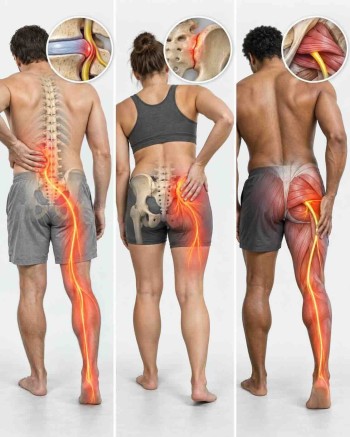
This surprises most people. Upper cervical chiropractic for lower back pain sounds counterintuitive. But the spine compensates. When the head tilts even slightly due to atlas misalignment, the rest of the spine shifts to rebalance — one shoulder drops, one hip rises, the pelvis rotates. That compensation pattern is a direct upstream cause of chronic lower back and sciatic pain.
Correcting the problem at the top frequently reduces the compensatory stress at the bottom, without anyone touching the lumbar spine at all.
Temporomandibular Joint (TMJ) Disorders
The jaw and the atlas share muscular and neurological real estate. Chronic jaw pain, teeth grinding, and clicking joints are frequently connected to upper cervical misalignment.
When the atlas shifts, the muscles attaching to the base of the skull and jaw are affected. Many TMJ patients who have cycled through dental splints and physical therapy find resolution only after their cervical alignment is addressed.
Post-Concussion Syndrome
Athletes, accident survivors, and anyone who has taken a significant blow to the head may develop lingering symptoms — brain fog, headaches, light sensitivity, mood changes — long after the initial injury.

These symptoms are increasingly understood to involve disrupted cerebrospinal fluid flow and brainstem stress, both directly influenced by upper cervical alignment.
This is one area where Charleston Upper Cervical Chiropractic at Ashley River Road has helped patients who felt they had run out of options.
What to Expect at Your First Visit
Your first appointment begins with a detailed health history and a conversation, not a table and a crack. Precision X-rays are taken to map your specific misalignment. No two atlas corrections are identical because no two misalignments are identical.
The adjustment itself takes seconds. You will likely be asked to rest briefly after, and follow-up X-rays confirm the correction held.
Results vary. Some patients notice changes within hours. Others need a series of corrections before the spine stabilizes in proper alignment. Honest practitioners will tell you both of those things.
Is Upper Cervical Chiropractic Right for You?
If you have been living with chronic headaches, dizziness, neck pain, or a diagnosis that has never fully explained your symptoms, upper cervical chiropractic is worth a serious conversation.
It is not a cure-all. It is a highly specific intervention for a highly specific structural problem — one that goes undetected in most conventional medical workups.
Charleston Upper Cervical Chiropractic is located at 1411 Ashley River Road, Charleston, SC 29407.
You can reach the office at (843) 225-5855 to schedule a consultation.

Leave a comment