

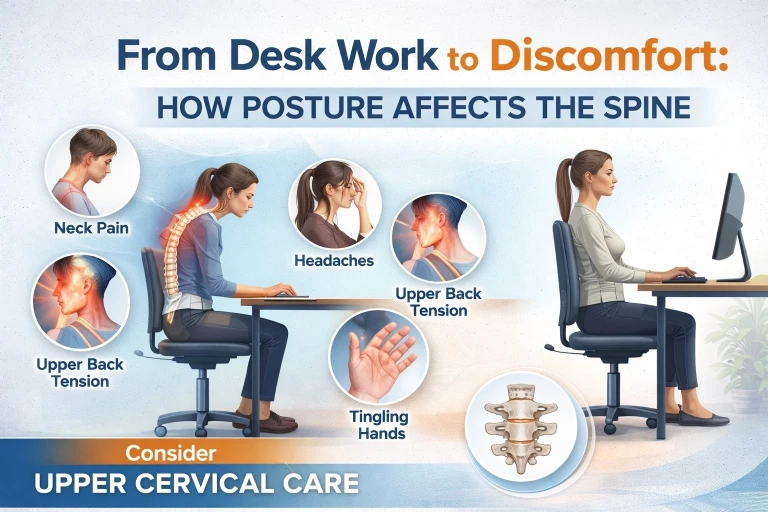
Modern work has shifted from movement to monitors. For millions of professionals, long hours at a desk are now the norm. While productivity may increase, so does physical strain. Neck stiffness, shoulder tension, headaches, and mid-back discomfort often begin subtly and then evolve into persistent issues.
Understanding how posture affects the spine, especially the upper cervical region, is essential for both prevention and long-term correction.
How Desk Work Changes Spinal Mechanics
The human spine is designed for movement. It thrives on variability: standing, walking, rotating, bending. Prolonged sitting interrupts this natural rhythm.
When someone sits for hours:
- The head gradually moves forward.
- The shoulders round inward.
- The upper back becomes flexed.
- The lower back loses its natural curve.
This posture, commonly referred to as forward head posture, significantly increases mechanical stress on the cervical spine.
For every inch the head moves forward, the effective load on the neck nearly doubles. Considering the average head weighs 10–12 pounds, even a small shift creates substantial strain on muscles, ligaments, and joints.
Over time, this altered alignment can affect the upper cervical spine — specifically the atlas (C1) and axis (C2).
Why the Upper Cervical Spine Is So Important
The upper cervical spine is structurally and neurologically unique. The atlas supports the skull, while the axis allows rotation. Together, they protect the brainstem and play a critical role in balance, coordination, and nervous system communication.
When desk posture causes chronic forward head positioning, the upper cervical region compensates to keep the eyes level. This compensation may lead to:
- Muscle guarding at the base of the skull
- Reduced cervical range of motion
- Tension headaches
- Altered proprioception
- Persistent neck tightness
Because this area houses the brainstem, even minor misalignments can influence how the body regulates muscle tone and postural stability.
Upper cervical chiropractic focuses specifically on evaluating and correcting subtle misalignments in this region.
The Posture–Pain Progression
The progression from desk posture to discomfort typically follows a predictable pattern:
1. Muscle Fatigue
Initially, muscles work harder to hold the head in an unsupported forward position. Fatigue develops.

2. Adaptive Tightness
The upper trapezius, levator scapulae, and suboccipital muscles shorten and become hypertonic.
3. Joint Restriction
Cervical joints begin to lose optimal motion due to sustained compression.
4. Neurological Irritation
Sustained mechanical stress can irritate surrounding nerve structures, leading to radiating symptoms or headaches.
5. Compensations Down the Chain
The body adapts further. The thoracic spine stiffens. The shoulders round. Even the lower back begins to compensate.
At this stage, treating only the site of pain often produces temporary relief. Addressing upper cervical alignment can change the underlying mechanics driving the cycle.
Common Symptoms Linked to Prolonged Desk Posture
People who work long hours at computers frequently report:
- Neck stiffness upon waking
- Mid-day headaches
- Shoulder blade burning
- Jaw tension
- Reduced neck rotation
- Tingling into the arms
- Generalized upper back tightness
While these symptoms may appear muscular, structural alignment often plays a contributing role.
Upper cervical chiropractors assess how the head sits on the spine, how weight is distributed, and whether subtle misalignments are creating chronic compensation patterns.
What Is Upper Cervical Chiropractic?
Upper cervical chiropractic is a specialized approach within chiropractic care that focuses on precise correction of the atlas and axis.
Unlike generalized spinal adjustments, upper cervical care uses detailed analysis, imaging (when appropriate), and gentle, targeted corrections.
The goal is not repeated forceful manipulation, but restoration of proper alignment so the nervous system can function without interference.
When the head is balanced correctly over the spine:
- Muscle demand decreases
- Postural endurance improves
- Joint stress reduces
- Headaches may diminish
- Movement efficiency increases
This becomes particularly relevant for individuals whose lifestyle requires extended desk work.
Why Ergonomics Alone Is Not Enough

Ergonomic chairs, standing desks, and monitor risers are helpful tools. However, they do not correct structural misalignment.
If the atlas is rotated or misaligned, the body will still compensate — even in a perfectly designed workspace.
This is why some individuals upgrade their desk setup but continue to experience symptoms.
Upper cervical chiropractic addresses structural positioning first. Once alignment improves, ergonomic changes become more effective and sustainable.
The Nervous System Connection
The brainstem passes directly through the upper cervical spine. This region influences:
- Muscle tone
- Balance
- Autonomic regulation
- Coordination
Prolonged postural stress can affect how efficiently the nervous system communicates with the rest of the body.
When upper cervical alignment is restored, many patients report not only reduced discomfort, but also improved focus, better sleep, and less fatigue.
While posture is mechanical, its impact is neurological.
Preventive Strategies for Desk Workers
In addition to seeking proper evaluation, desk workers can support spinal health through:
Movement Breaks
Stand and move every 30–45 minutes.
Screen Position
Keep the top third of the monitor at eye level.
Shoulder Position
Maintain relaxed shoulders rather than elevated tension.
Chin Retraction Drills
Gently pull the chin backward to counter forward head posture.
Thoracic Mobility Work
Encourage extension of the mid-back to offset rounding.
However, if symptoms persist despite these changes, structural evaluation becomes essential.

When to Consider Upper Cervical Care
You may benefit from upper cervical chiropractic evaluation if you experience:
- Chronic neck stiffness
- Recurring tension headaches
- Symptoms that return quickly after massage or stretching
- Persistent forward head posture
- Discomfort that worsens during computer work
Early correction often prevents long-term degenerative changes.
Long-Term Consequences of Ignoring Posture
Left unaddressed, chronic desk posture can contribute to:
- Cervical disc degeneration
- Early arthritic changes
- Chronic tension patterns
- Reduced spinal mobility
- Increased injury susceptibility
The longer compensations exist, the more ingrained they become.
Upper cervical correction, combined with ergonomic awareness and strengthening, offers a proactive solution rather than reactive symptom management.
Frequently Asked Questions
1. Can poor posture really cause neck pain?
Yes. Forward head posture significantly increases load on the cervical spine, leading to muscle fatigue and joint stress.
2. What is the upper cervical spine?
It includes the first two vertebrae (C1 and C2), which support the skull and protect the brainstem.
3. Is upper cervical chiropractic safe?
Upper cervical care uses precise, gentle corrections and is considered low-force compared to traditional adjustments.
4. How long does it take to see improvement?
Response varies, but many individuals report changes within the first few visits depending on severity and duration of misalignment.
Final Thoughts
Desk work is not inherently harmful. The problem lies in sustained, uncorrected posture.
The spine adapts to the positions it lives in. When that position is forward-flexed for hours each day, structural and neurological consequences follow.
Upper cervical chiropractic offers a focused, precision-based approach to restoring alignment at the top of the spine, the region that influences the entire system.
Correct the foundation. Improve posture. Reduce strain.
The solution is not simply sitting straighter. It is ensuring the head and spine are structurally balanced in the first place.



Leave a comment