

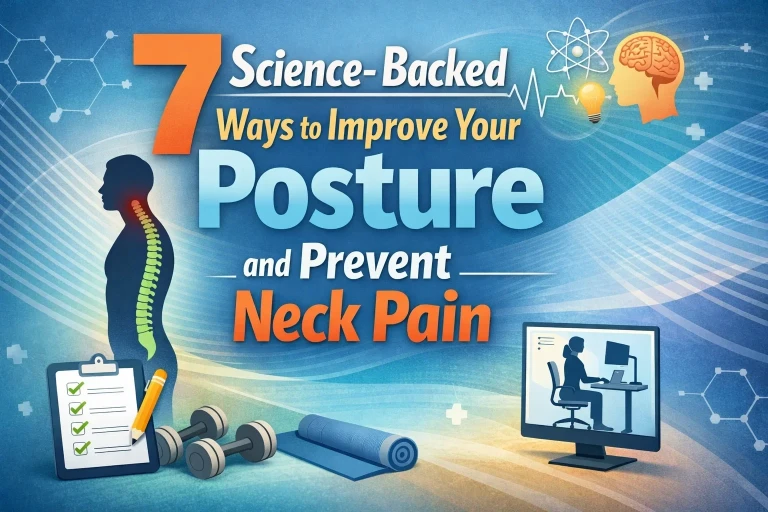
Poor posture is the leading preventable cause of chronic neck pain, headaches, and upper back discomfort. The good news: you can dramatically improve your posture and prevent pain through seven evidence-based strategies including upper cervical alignment, strengthening exercises, ergonomic workspace setup, movement breaks, sleep position optimization, stress management, and professional assessment.
These natural, non-medication approaches address the root causes of postural dysfunction rather than masking symptoms.
What Matters Most
- Impact: Forward head posture adds 10 pounds of pressure to your neck for every inch forward
- Prevalence: 80% of office workers develop postural neck pain during their careers
- Prevention success: Studies show 70% reduction in neck pain with proper posture intervention
- Timeline: Most people notice improvement within 2-4 weeks of consistent practice
- No medication required: These strategies work naturally to prevent and reverse postural problems
Medical Disclaimer: This content is for informational purposes only and does not constitute medical advice. The information provided should not be used for diagnosing or treating health problems or diseases. Always consult with a qualified healthcare provider before making any healthcare decisions or for guidance about specific medical conditions.
Why Posture Matters More Than You Think
Your posture affects far more than how you look. The position of your head, neck, and spine influences nervous system function, breathing capacity, energy levels, pain perception, and even mood. Research published in Health Psychologyfound that people with slumped posture experienced more negative moods, lower self-esteem, and increased fear compared to those sitting upright.
From a mechanical perspective, your skull weighs approximately 10-12 pounds. When properly positioned directly over your spine, this weight distributes evenly through your skeletal structure, requiring minimal muscular effort to maintain. However, the modern lifestyle, hours spent looking at screens, driving, and sitting, has created an epidemic of forward head posture, or "tech neck."
For every inch your head moves forward from its optimal position, your neck experiences an additional 10 pounds of stress. Someone with just 3 inches of forward head posture forces their neck muscles to support 40-42 pounds instead of 10-12 pounds. Maintained hour after hour, day after day, this creates:
- Chronic muscle fatigue and spasm
- Increased pressure on cervical discs
- Nerve compression and irritation
- Reduced blood flow to the brain
- Breathing restriction
- Accelerated degenerative changes
The solution isn't quick fixes or medications that mask symptoms. Real improvement requires addressing the root causes of poor posture through consistent, evidence-based strategies.
Strategy 1: Get Your Upper Cervical Spine Professionally Assessed
The Foundation of Good Posture Starts at the Top
Your atlas vertebra (C1) literally holds up your head, and even minor misalignments in this critical area create cascading postural problems throughout your entire spine. When the atlas shifts out of position, your body compensates by tilting your head, raising one shoulder, shifting your hips, or rotating your pelvis—all in an attempt to keep your eyes level and maintain balance.
Why This Matters:
Research published in the Journal of Physical Therapy Science demonstrated that correcting upper cervical misalignment produces immediate improvements in overall postural alignment, with effects measurable throughout the entire spine. Participants showed average improvements of 15-20 degrees in forward head posture after upper cervical correction.
How to Implement:
Schedule a professional assessment with an upper cervical chiropractor who uses precision X-ray analysis to measure alignment. Unlike general postural analysis, upper cervical specialists use advanced imaging and computer analysis to detect misalignments measured in fractions of a degree.
What to expect:
- Comprehensive postural analysis from multiple angles
- Precision X-rays showing exact vertebral positioning
- Neurological assessment identifying nerve interference
- Specific correction plan based on your unique misalignment pattern
The upper cervical correction process:
- Initial assessment identifies misalignment direction and degree
- Gentle, precise adjustment restores proper atlas position
- Post-correction rest period allows stabilization
- Follow-up measurements confirm correction
- Ongoing monitoring maintains optimal alignment
Timeline: Most people notice postural changes within 1-3 adjustments, with optimal results in 8-12 weeks as the body adapts to proper alignment.
Cost consideration: While there's an investment in professional care, correcting the structural foundation of posture prevents years of chronic pain, medication dependence, and progressive deterioration.
Charleston-specific: If you're in Charleston, SC, specialized upper cervical care using techniques like Knee Chest provides gentle, precise corrections without forceful manipulation. Local practitioners focus on achieving stable, lasting alignment with minimal intervention.
Strategy 2: Strengthen Your Deep Neck Flexor Muscles
The Hidden Muscles That Control Head Position
Most people focus on stretching tight neck muscles while ignoring the deeper problem: weak deep neck flexors. These muscles, longus colli and longus capitis, attach to the front of your cervical vertebrae and are responsible for keeping your head properly positioned over your spine.
Research in Manual Therapy found that people with chronic neck pain consistently demonstrate 30-40% weaker deep neck flexors compared to pain-free individuals. Strengthening these muscles is one of the most effective interventions for improving posture and preventing pain.
The Science:
When deep neck flexors are weak, superficial muscles (sternocleidomastoid, upper trapezius, levator scapulae) compensate by working overtime. This creates the characteristic forward head posture, muscle tension, and pain. Strengthening the deep stabilizers allows the superficial muscles to relax, naturally improving head position.
Strategy 3: Optimize Your Workspace Ergonomics
Where You Spend 8+ Hours Daily Matters Most
If you work at a computer, your workspace setup directly determines your posture. Poor ergonomics force your body into harmful positions for hours daily, creating chronic postural strain that no amount of exercise can fully counteract.
The Ergonomic Research
A comprehensive study in Applied Ergonomics found that proper workstation setup reduced neck pain by 52% and headaches by 67% among office workers. The intervention cost was minimal, mostly adjusting existing equipment and educating workers on proper positioning.
The 90-90-90 Rule for Optimal Sitting:
- Hips: 90-degree angle, knees level with or slightly below hips
- Knees: 90-degree angle, feet flat on floor or footrest
- Elbows: 90-degree angle when hands on keyboard
Critical Ergonomic Adjustments
Monitor Position (Most Important):
- Height: Top of screen at or slightly below eye level
- Distance: Arm's length away (20-26 inches)
- Angle: Screen tilted slightly upward, perpendicular to your line of sight
- Why it matters: Improper monitor height is the primary cause of forward head posture at work
Keyboard and Mouse:
- Keyboard directly in front of you (not angled to side)
- Mouse at same height as keyboard, close to body
- Wrists neutral—not bent up, down, or to side
- Shoulders relaxed, not hunched
Chair Setup:
- Lumbar support contacting your low back
- Seat depth allows 2-3 fingers space behind knees
- Armrests supporting elbows at 90 degrees
- Seat height allowing feet flat on floor
Laptop Users (Special Considerations):
Laptops force compromise between screen height and keyboard position.
Solutions:
- Use external monitor (or laptop riser) plus external keyboard and mouse
- If no external equipment available: prop laptop on books to raise screen, use external keyboard
- Never work with laptop on lap, this guarantees poor posture
Phone and Device Use:
- Hold phone at eye level when reading/scrolling
- Use speakerphone or headset for calls (avoid phone pinched between shoulder and ear)
- Take breaks every 10-15 minutes during extended phone use
- Consider phone stand or holder at desk
Document Position:
- Use document holder at same height/distance as screen
- Avoid repeatedly looking down at papers on desk
- Position between keyboard and monitor when referencing frequently
Strategy 4: Implement the 20-20-20 Movement Rule
Breaking the Static Posture Trap
Prolonged static posture, staying in one position for extended periods, causes more postural problems than occasional poor positioning. Your body is designed for movement, and staying still creates muscle fatigue, reduced circulation, and tissue stiffness.
The Research:
Studies published in Ergonomics demonstrate that regular movement breaks reduce neck and shoulder discomfort by 50% compared to uninterrupted sitting. The benefits come not from exercise during breaks, but simply from changing positions and allowing muscles to recover.
The 20-20-20 Rule:
Every 20 minutes:
- Take a 20-second break
- Look at something 20 feet away
- Move for 20 seconds
This simple protocol prevents eye strain, allows postural muscles to recover, and maintains tissue flexibility.
Practical Implementation:
Set automatic reminders:
- Phone timer or alarm
- Computer software (apps like Stretchly, Time Out, or Awareness)
- Smart watch with movement reminders
- Browser extensions that prompt breaks
- What to do during 20-second breaks:
Seated micro-movements:
- Roll shoulders backward 5 times
- Do 3-5 chin tucks
- Side bend neck gently each direction
- Interlace fingers and stretch arms overhead
- Rotate torso gently left and right
- Flex and extend ankles and wrists
Standing breaks (better option):

- Stand up and sit down 3 times
- Walk to window and look outside
- March in place for 20 seconds
- Do 5 standing arm circles
- Walk to refill water bottle
The Extended Break Protocol:
Beyond the 20-20-20 rule, implement longer breaks:
Every 60 minutes: 2-3 minute movement break
- Walk to different room or around office
- Stretch major muscle groups
- Do full posture reset routine
- Change working position (stand vs. sit)
Every 2 hours: 5-minute activity break
- Walk outside if possible
- Climb stairs
- Do complete stretching routine
- Practice stress-reduction breathing
Movement Variation Throughout Day:
Rather than maintaining one "perfect" posture all day, vary your positions:
- Alternate between sitting and standing (if sit-stand desk available)
- Change sitting positions periodically
- Use different chairs or seating options
- Take phone calls while walking when possible
- Hold walking meetings instead of conference room meetings
The Science of Position Change:
Research shows that varying positions throughout the day is more beneficial than maintaining perfect static posture. Position changes:
- Redistribute pressure on spinal discs
- Prevent muscle fatigue from sustained contraction
- Maintain tissue flexibility
- Support circulation
- Reduce perceived discomfort
Tracking Your Success:
Monitor your compliance for two weeks:
- Set goal: 20-20-20 breaks during all computer work
- Track: Mark calendar each hour you successfully complete
- Reward: Acknowledge when you hit 80%+ compliance
- Adjust: Identify barriers and problem-solve
Expected Results:
Most people notice immediate benefits:
- Same day: Reduced eye strain and facial tension
- Week 1: Less end-of-day neck stiffness
- Week 2: Improved ability to maintain good posture
- Week 4: Significant reduction in chronic neck pain and headaches
Real-world adaptation:
"I can't take breaks every 20 minutes—I'm too busy!" This is the most common objection. Reality check: 20 seconds every 20 minutes totals just 3 minutes per hour. You'll be more productive with brief breaks than working through fatigue with declining posture and increasing pain.
Strategy 5: Perfect Your Sleep Position and Pillow Setup
One-Third of Your Life Affects the Other Two-Thirds
You spend roughly 6-9 hours sleeping every night—that's one-third of your life in one position. Poor sleep posture undoes your daytime postural efforts and creates chronic strain that accumulates over years.
The Sleep Posture Research:
Studies in The Spine Journal found that sleep position significantly impacts neck pain, with stomach sleeping being the worst position and back or side sleeping with proper support being optimal. Participants who changed from stomach to back/side sleeping experienced 30-40% reduction in morning neck pain within two weeks.
The Worst Position: Stomach Sleeping
Sleeping on your stomach forces several harmful positions:
- Head rotated 90 degrees for hours (severe strain on upper cervical spine)
- Low back hyperextension (increased lumbar stress)
- Chest compression (reduced breathing capacity)
- Unnatural spinal alignment throughout entire spine
If you currently sleep on your stomach, changing positions is the single most important postural intervention you can make.
Optimal Sleep Positions:
Back Sleeping (Best for Most People):
Proper setup:
- Pillow supporting natural cervical curve
- Pillow height: fills space between mattress and neck without pushing head forward
- Small roll or towel under neck curve for additional support
- Pillow under knees to reduce low back stress
- Arms at sides or on chest (not overhead, which strains shoulders)
Benefits:
- Maintains neutral spine alignment
- Even pressure distribution
- Reduced facial wrinkles (bonus!)
- Minimizes reflux symptoms
Pillow selection for back sleepers:
- Thinner pillow than side sleepers need
- Memory foam or cervical pillow with contour
- Should support neck curve while keeping head neutral
- Side Sleeping (Good Alternative):
Proper setup:
- Pillow filling space between shoulder and head
- Pillow height: keeps head aligned with spine (not tilted up or down)
- Pillow between knees reducing hip/low back strain
- Full-length body pillow preventing rolling forward
- Alternate sides periodically (don't always favor same side)
Benefits:
- Good for people who can't tolerate back sleeping
- Reduces snoring
- Good for pregnant women
- Comfortable for many people
Pillow selection for side sleepers:
- Thicker, firmer pillow than back sleepers
- Should fill shoulder-to-head space completely
- Memory foam, latex, or shredded foam options
- Must maintain height throughout night
Transitioning from Stomach Sleeping:
This is challenging but achievable with persistence:
Week 1-2: Tennis Ball Method
- Sew or tape tennis balls into front of old t-shirt
- Wear to bed
- Makes stomach position uncomfortable, encouraging position change
- Most people begin tolerating back/side position within 10-14 days
Alternative method: Pillow barriers
- Place firm pillows on either side of body
- Creates physical boundary preventing rolling to stomach
- Remove after successfully maintaining back/side position for 2 weeks
The Pillow Replacement Rule:
Replace pillows every 1-2 years. Old pillows lose support, forcing poor neck positions. Quick test: Fold pillow in half, if it doesn't spring back, it's dead and needs replacement.
Pillow Quality Indicators:
Good pillow maintains:
- Proper loft (height) throughout night
- Supportive firmness appropriate to sleeping position
- Cool temperature (doesn't trap excessive heat)
- Hypoallergenic properties
Recommended pillow types:
Memory Foam:
- Pros: Conforms to neck, good support, durable
- Cons: Can sleep hot, initial odor, firmness varies with temperature
- Best for: Back sleepers, those wanting contouring
Latex:
- Pros: Natural material, stays cool, very durable, supportive
- Cons: More expensive, heavy, limited contouring
- Best for: Side sleepers, those wanting firmer support
Shredded Foam:
- Pros: Adjustable loft, moldable, good airflow
- Cons: Can flatten, may shift during night
- Best for: People who change positions, want customization
Cervical/Contour Pillows:
- Pros: Specifically designed for neck support, medical-grade options
- Cons: Adjustment period, position-specific, can't be used for side and back equally
- Best for: People with chronic neck pain, upper cervical patients
Mattress Considerations:
While pillow choice is critical, mattress matters too:
- Should support natural spinal curves
- Not so soft you sink excessively
- Not so firm it creates pressure points
- Replace every 7-10 years
- Medium-firm generally best for most people
Expected Results:

Sleep position optimization produces cumulative benefits:
- Week 1: Reduced morning stiffness
- Week 2-3: Decreased morning headaches
- Week 4-6: Improved daytime posture (night and day posture linked)
- Week 8+: Significant reduction in chronic neck pain
Charleston climate consideration: Charleston's humidity makes cooling pillows particularly valuable. Look for gel-infused memory foam or latex options with moisture-wicking covers.
Strategy 6: Practice Stress-Reduction Techniques
The Mind-Body Posture Connection
Stress doesn't just affect your mood, it directly impacts your posture. Under stress, your body activates the "fight or flight" response, causing muscles to tense, shoulders to rise, and head to jut forward. Chronic stress creates chronically poor posture.
The Research:
Studies in Psychosomatic Medicine demonstrate that psychological stress increases muscle tension in the neck and shoulders by 40-60%. Furthermore, people under chronic stress show significantly worse posture than low-stress individuals, independent of other factors.
How Stress Affects Posture:
Physiological changes:
- Increased muscle tension (particularly upper trapezius, levator scapulae)
- Elevated shoulders and forward head position
- Shallow breathing patterns (reduces rib cage expansion)
- Jaw clenching (creates upward tension chain)
- Reduced body awareness (don't notice poor posture)
Behavioral changes:
- Less likely to take movement breaks
- Poor sleep quality (compounds postural problems)
- Comfort-seeking positions (slouching)
- Reduced exercise and self-care
Evidence-Based Stress Reduction Techniques:
Deep Breathing (Most Accessible):
The 4-7-8 Breathing Technique:
- Exhale completely through mouth
- Inhale quietly through nose for 4 counts
- Hold breath for 7 counts
- Exhale completely through mouth for 8 counts
- Repeat cycle 4 times
Benefits:
- Activates parasympathetic nervous system
- Reduces muscle tension within minutes
- Improves awareness of breath and posture
- Can be done anywhere, anytime
Practice schedule:
- Morning upon waking
- Before stressful situations
- During work breaks
- Before bed
Progressive Muscle Relaxation:
Systematically tense and release muscle groups:
- Start with feet, tense for 5 seconds, release
- Move upward through calves, thighs, abdomen
- Continue through chest, arms, shoulders
- Finish with neck and facial muscles
- Complete sequence takes 10-15 minutes
Benefits specific to posture:
- Increases awareness of muscle tension
- Teaches difference between tense and relaxed states
- Directly reduces postural muscle tightness
- Improves body awareness
Mindfulness Meditation:
Research shows just 10 minutes daily of mindfulness meditation:
- Reduces perceived stress by 30-40%
- Decreases muscle tension
- Improves body awareness and posture consciousness
- Enhances overall well-being
Simple practice:
- Sit comfortably with good posture
- Focus on breath moving in and out
- When mind wanders, gently return attention to breath
- Start with 5 minutes, build to 10-20 minutes
Physical Activity for Stress:
Exercise is one of the most effective stress reducers:
- Walking: 20-30 minutes daily reduces stress hormones
- Yoga: Combines movement, breathing, and mindfulness
- Swimming: Excellent full-body stress relief
- Tai Chi: Gentle movement with postural benefits
Charleston-specific stress reduction:
- Beach walks (Sullivan's Island, Folly Beach)
- Waterfront Park morning walks
- Historic district strolls
- Kayaking or paddleboarding
- Outdoor yoga at local parks
Posture-Stress Reset Routine:
5-Minute desk break combining stress relief and posture:
- Stand up, roll shoulders back 10 times (30 sec)
- Do 5 deep breaths with 4-7-8 pattern (90 sec)
- Gentle neck stretches—each direction 15 sec (60 sec)
- Arm circles and overhead reaches (30 sec)
- Progressive tension-release of shoulders and neck (90 sec)
- Return to work with postural awareness (30 sec)
Expected Results:
Combining stress reduction with posture work amplifies benefits:
- Immediate: Reduced muscle tension after each practice
- Week 1-2: Improved stress perception and body awareness
- Week 3-4: Noticeable reduction in stress-related neck tension
- Week 6-8: Significantly improved posture maintenance and reduced pain
Important note: If stress feels overwhelming or you're experiencing anxiety or depression symptoms, seek professional support. Stress management techniques complement but don't replace professional mental health care when needed.
Strategy 7: Schedule Regular Professional Posture Assessments
Expert Guidance Accelerates Progress
While self-care strategies are essential, professional guidance ensures you're addressing your specific postural issues correctly and efficiently. What works for one person may not work for another due to individual biomechanics, structural problems, or compensatory patterns.
Why Professional Assessment Matters:
Identify hidden problems:
- Structural misalignments you can't see or feel
- Muscle imbalances requiring specific interventions
- Compensatory patterns masking primary problems
- Risk factors for future injury
Customize your approach:
- Exercises specific to your imbalances
- Modifications based on your lifestyle
- Realistic timeline based on your condition
- Accountability and progress tracking
Types of Professionals for Posture Assessment:
Upper Cervical Chiropractors (Structural Foundation):
- Precision analysis of upper cervical alignment
- Correction of atlas/axis misalignments
- Whole-body postural assessment
- Integration with other strategies
- Particularly important for anyone with past head/neck trauma
Physical Therapists (Movement and Strength):
- Detailed movement analysis
- Customized exercise programs
- Manual therapy for tight tissues
- Functional movement training
Certified Personal Trainers (Strength and Conditioning):
- Exercise form correction
- Progressive strength programs
- Accountability and motivation
- Functional fitness integration
What to Expect in Professional Assessment:
Upper Cervical Evaluation:
- Comprehensive health history and injury review
- Postural photography and analysis
- Neurological assessment (thermography, leg length)
- Precision X-rays if indicated
- Specific correction plan
- Education on maintaining alignment
- Integration with home care strategies
Professional care represents an investment in long-term health:
- Prevention is cheaper than treatment: Addressing posture now prevents costly interventions later
- Medication reduction: Better posture often eliminates need for pain medications
- Work productivity: Reduced pain improves focus and efficiency
- Quality of life: Pain-free living is invaluable
Combining professional care with self-care strategies produces best outcomes:
- Faster results: Professional care accelerates improvement
- Better outcomes: Customized approach addresses your specific issues
- Lasting change: Structural correction prevents problem recurrence
- Education: Understanding why problems occurred prevents future issues
Frequently Asked Questions
1. How long does it take to fix forward head posture?
The timeline for correcting forward head posture depends on severity, duration, and consistency with interventions. For mild forward head posture (1-2 inches) that's recent, you can see noticeable improvement in 3-4 weeks with consistent exercise and ergonomic changes.

Moderate forward head posture (2-3 inches) present for months typically improves significantly in 6-8 weeks. Severe forward head posture (3+ inches) or chronic issues lasting years may require 3-6 months for substantial correction.
2. How long you've had the problem (recent vs. chronic)
- Severity of misalignment
- Whether structural correction (upper cervical) is included
- Consistency with exercises and postural awareness
- Your age and tissue adaptability
Lifestyle factors (job, stress, sleep)
Important: You'll feel improvements before you see dramatic changes. Most people notice reduced pain and muscle tension within the first 2 weeks, even though visible postural changes take longer.
Schedule a professional assessment if you're not seeing progress after 4-6 weeks of consistent self-care, structural issues may require professional intervention.
3. Can you fix posture permanently or will it always come back?
This depends on whether you address the root causes versus just treating symptoms. If you only do occasional stretching or use posture-reminder devices without addressing structural misalignment, muscle weakness, and lifestyle factors, posture will likely deteriorate again.
However, permanent improvement is achievable when you:
- Correct any underlying structural misalignments (especially upper cervical)
- Build strength in postural stabilizing muscles
- Maintain ergonomic workspace and sleep setups
- Continue movement breaks and body awareness
- Receive periodic professional assessments
Think of posture like dental health: you can achieve healthy teeth, but you must continue daily brushing and periodic professional cleanings. Similarly, good posture requires ongoing self-care and occasional professional check-ups.
Most people find that:
- Initial intensive effort (2-3 months) establishes good posture
- Ongoing habits maintain improvements with less conscious effort
- Periodic professional care (every few months) prevents regression
- Good posture becomes more natural and automatic over time
The good news: Once you've corrected structural problems and built strength, maintaining good posture requires far less effort than achieving it initially.
4. Is it too late to improve my posture if I'm over 50?
Absolutely not! While tissue adaptability does decrease with age, postural improvement is achievable at any age. Research shows that adults in their 60s and 70s experience significant posture improvements with appropriate interventions.
Age-related considerations:
- Tissue changes may take slightly longer (add 2-4 weeks to expected timelines)
- Strength building is still very effective but progresses more gradually
- Professional guidance becomes more important to ensure safe, effective approach
- Degenerative changes (arthritis) may be present but don't prevent improvement
- Benefits are actually more pronounced—pain relief dramatically improves quality of life
Special advantages for older adults:
- More motivated to address chronic pain
- Often more consistent with exercise programs
- May have more flexible schedule for appointments and self-care
- Appreciate functional improvements (stairs, gardening, playing with grandchildren)
Age-appropriate modifications:
- Gentler progression of strengthening exercises
- May need longer warm-up before stretching
- Extra attention to balance during exercises
- Focus on functional improvements relevant to daily life
- Professional assessment especially valuable to customize approach
Charleston senior resources: Many local senior centers, gyms, and community programs offer appropriate classes and support for postural improvement at any age.
5. What's better for posture, standing desk or sitting desk?
Neither is inherently "better", the key is variation and movement. Research shows that alternating between sitting and standing is more beneficial than doing either exclusively.
Problems with sitting all day:
- Sustained hip flexion tightens hip flexors
- Prolonged forward head position
- Reduced calorie expenditure
- Circulation restrictions
Problems with standing all day:
- Leg and foot fatigue
- Potential varicose vein development
- Low back strain if poor posture maintained
- Hip and knee stress
Optimal approach: Sit-stand variation
- Alternate positions every 30-60 minutes
- Start with 50% sitting, 50% standing
- Adjust ratio based on comfort and fatigue
- Movement breaks important in both positions
If you can't get a sit-stand desk:
- Take regular standing breaks from sitting
- Use high counter or shelf for occasional standing work
- Walk during phone calls
- Standing meetings when possible
Sitting desk optimization:
- Perfect your ergonomic setup (Strategy 3)
- Take movement breaks every 20 minutes
- Change sitting positions periodically
- Use active sitting (exercise ball for short periods)
Standing desk optimization:
- Anti-fatigue mat reduces leg strain
- One foot on low stool alternating reduces back strain
- Monitor still at proper height
- Wear supportive shoes
Bottom line: Movement and variation matter more than sitting vs. standing. The worst posture is the one you maintain for hours without change.
5. Do posture corrector braces actually work?
Posture corrector braces provide temporary assistance but don't create lasting change and may actually weaken postural muscles if overused.
How they work:
- Physical reminder to maintain upright position
- Passively pull shoulders back
- Make slouching uncomfortable
Problems with long-term use:
- Muscles adapt by becoming weaker (they're not working)
- Remove the brace and posture often worsens
- Don't address underlying causes (structural, strength, ergonomic)
- Can create dependency
- May restrict breathing if too tight
- Don't teach body awareness or proper movement patterns
When they might be helpful:
- Short-term use (2-3 weeks) while building strength
- Temporary reminder during highest-risk activities
- During recovery from injury (under professional guidance)
- As feedback tool, not permanent solution
Better approaches:
- Strengthen postural muscles (they become your internal brace)
- Correct structural alignment professionally
- Improve workspace ergonomics
- Develop postural awareness
Address root causes
If you're considering a brace: Use it as temporary support while implementing the 7 strategies in this article. Gradually reduce brace use as your strength and alignment improve. Never rely on a brace as your only intervention.
6. Can smartphone use really cause permanent neck damage?
Yes, excessive smartphone use with poor positioning can cause lasting structural changes to the cervical spine. Research using advanced imaging shows that people with chronic "tech neck" develop:
Measurable changes:
- Straightening or reversal of normal cervical curve
- Early degenerative disc changes
- Accelerated arthritis development
- Chronic ligament strain
- Persistent muscle imbalances
The mechanism:
- Average head weighs 10-12 pounds
- Tilted forward 60 degrees (typical phone viewing angle), effective weight becomes 60 pounds
- Sustained hours daily creates cumulative stress measured in tons of force over years
- Structures adapt to chronic stress through degenerative changes
Age-related concern:
Teenagers and young adults with decade+ of heavy smartphone use showing neck changes typically seen in 40-50 year olds
Earlier onset, more advanced changes by middle age
Potentially lifelong consequences
Prevention strategies:
- Hold phone at eye level when reading or scrollingTake breaks every 10-15 minutes
- Limit recreational screen time
- Use voice features instead of typing when possible
- Do daily chin tuck exercises to counteract forward positioning
- Get professional assessment if experiencing chronic neck pain
Good news: Early intervention can prevent permanent changes. If you're experiencing symptoms now, addressing positioning and getting structural assessment can prevent long-term damage. The changes are progressive, the earlier you intervene, the better the outcome.
For parents: Model good smartphone posture for children and set reasonable screen time limits. Habits formed in youth often persist into adulthood.
Ready to Take Control of Your Posture?
If you're in Charleston, South Carolina, and your assessment indicates moderate to high priority, professional upper cervical evaluation can identify structural issues preventing postural improvement. Don't let chronic poor posture progress to permanent degenerative changes.
Remember: The best time to address posture was 10 years ago. The second best time is today. Small changes implemented consistently produce remarkable results over weeks and months.
Final takeway
Improving your posture and preventing neck pain doesn't require medication, expensive equipment, or hours of daily effort. The seven evidence-based strategies outlined in this article, upper cervical alignment, strengthening exercises, ergonomic optimization, movement breaks, sleep position correction, stress management, and professional assessment, address the root causes of poor posture rather than masking symptoms.
Most people notice significant improvements within 4-8 weeks of consistent implementation. The key is understanding that posture isn't just about "sitting up straight", it's about correcting structural misalignments, building appropriate strength, optimizing your environment, and maintaining body awareness throughout daily activities.
Whether you're dealing with chronic pain or want to prevent future problems, these strategies work synergistically to create lasting postural improvement. Start with the areas most relevant to your situation, build consistency over weeks, and consider professional guidance to accelerate results and ensure you're addressing your specific needs effectively.
Your posture affects far more than appearance, it influences pain levels, energy, mood, and long-term spinal health. The investment in correcting posture now prevents years of chronic pain and degeneration later.


Leave a comment